SSS 30. King Khushru Parviz – Khushru / Cosroe II (591-628) (Part 7)

A bad leader is the best revenge

Since Behram Chobin was from Rae, and since its people were very faithful to him, Khushru wanted to destroy this province. His ministers advised him against it, as there were many good people too, over there. Then the king decided to punish the people of Rae by appointing a very bad leader for them.  The ministers were surprised by the king’s decision.

The king found the ugliest and cruelest of persons and made him the head of the province of Rae. The man perpetrated atrocities on people and animals of Rae and so most people deserted the province. The king was happy with his revenge.

News of this reached Gordui, who then conveyed it to Gordiyeh, requesting her to do something about it. Gordiyeh talked to the king and convinced him to recall the tyrant leader and grant her the administration of Rae. The king, his purpose served, handed over the province of Rae to Gordiyeh.

Beneficial changes by the king

King Khushru introduced several measures for happiness and safety of his kingdom and his subjects. He sent armies of twelve thousand soldiers each near borders of Rome, Zabulistan, Alāna and Khorasan to guard against any enemy intrusions in Iranian territory.

For his own life, the king divided his day into four parts. In the first part, the ministers were to inform the king about matters related to the army and the administration of the country, so that he can mete out justice. The second part of the day was dedicated to music, enjoyment and socializing with the courtiers. The third section of the day was devoted to prayers. The fourth part of the day was subdivided into two parts, one dedicated to learning astronomy and astrology, and the other, to be spent with beautiful maidens in his harem.

King Khushru also subdivided his month into four parts, for purpose of his own activities. The first part was for sports and archery, the second part was for hunting, discussing war strategy and playing intelligent games like chess and back-gammon.  The third part was dedicated to writing and reading history. In the fourth part, the king met envoys and ambassadors from far off countries, and replied to their letters. On the day of Navroz, when the sun entered the house of Aries, the king secretly gave a lot of charities.

Rise of the Arabs

In 610 CE, Noman, the chief of the Arab state of Hira, situated between the Euphrates and Jerusalem, was attacked and imprisoned by Khushru. One of his commanders, the Shaybani leader Hani came to represent Noman before the Iranian king, but he too was imprisoned and later executed.

Khushru then ordered the Shaybani and Hira people to surrender, but they did not. Khushru sent an army comprising of Arab and Persian soldiers to overpower Hira and Shaybani. The two armies met at Dhu-Qar (near Kufa in modern Iraq). The Arab component of the Iranian army deserted leading to the defeat of the Iranians.

At his point of time prophet Mohammad had just appeared. This victory of the Arabs was a great morale booster, and gave an impetus to the Arab tribes to unite. It is said, that if the battle of Dhu-Qar had been won by the Iranians, the emergence of Islam would not have been the same, because the morale of the Arab tribes would have been destroyed.

Prophet Mohammad

It is a well-known fact that prophet Mohammad appeared during the reign of Khushru II. Though the Shahnameh does not mention this, Islamic tradition tells a story in which Prophet Muhammad sent a messenger Abdullah ibn Hudhafah as-Sahmi, to Khushru along with a letter in which the king Khosrow was asked to accept the religion of Islam. In the letter it was stated, “From Muhammad, the Messenger of Allah, to Kisra, the great (leader) of the Persians. Under the Command of Allah, I invite you to Him. He has sent me for the guidance of all people so that I may warn them all of His wrath and may present the unbelievers with an ultimatum. Embrace Islam so that you may remain safe in this life and the next. And if you refuse to accept Islam, you will be responsible for the sins of the Magi.”

Islamic tradition further states that Khushru tore up the prophet’s letter. He commanded Badhan, his vassal ruler of Yemen, to dispatch two men to bring the prophet to him. When Abdullah told Prophet Muhammad how Khushru had torn his letter, the prophet promised the destruction of the Iranian king stating, “Even so, Allah shall destroy his kingdom”.

Dastur Dinyar, Salman-i-Fars

The account of this righteous person is from Zoroastrian and Islamic traditions, and not from the Shahnameh. Dastur Dinyar, also known as Behzad or Rozbeh, was a saintly and knowledgeable priest during the reign of king Khushru II.  However, he is more popularly known as Salman-i-Fars “Solomon (the wise man) of Persians”. In those times of internal discord and strife, Dastur Dinyar is said to have tried hard to bring about unity, amity and peace among the opposing factions of the Iranian royalty, and hence became unpopular among the warring factions.

He was arrested for a crime he did not knowingly commit. Tradition tells us that he inadvertently hurt his mother, and was hence forced to flee Iran, rather than be prosecuted. Some traditions say that the king himself helped him to flee as he was convinced of his piety and innocence.

He took refuge at Medina where he later became associated with Prophet Muhammad, who recognized his value. He became an asset to the prophet and assisted him in all his works. He helped the prophet in writing the Quran (Quran XVI-105).

The Prophet had constituted a council of advisers of which Dastur Dinyar was an important member, and belonged to his ‘inner circle’. He was also one of the most revered among the Ashab “companions” of the Prophet. In the Hadith, it is stated that “Salman Minna aht al-Bait”, that is, “Salman is one of us”.

There are traditions in the Islamic sources describing Salman and his journey to Islam. A chapter in the Hadith collection Bihar al-anwar “Oceans of light” is devoted to Salman’s journey and opinions about him by the Prophet and Shia Imams.

Dastur Dinyar survived the prophet and staunchly supported Ali and his family during the schism that followed the prophet’s passing away. Esoteric Islam began to blossom under Hazrat Ali in the influence of Salman-e-Fars.

It was on account of Dastur Dinyar’s wisdom, learning and piety, that he was referred to as Salman i Fars “the Parsi Solomon.”

To be continued…..
SSS 29. King Khushru Parviz – Khushru / Cosroe II (591-628) (Part 6)

The end of Behram Chobin

Kharrād, the emissary of Iranian king Khushru was not able to persuade the Chinese king to handover the rebel Behram to the Iranian king.  Hence he decided to change his strategy.

He was aware of Kalun, an aged Turkish warrior, who was a relative of Makātureh, and held a grudge against Behram after he had killed Makātureh. Right since that time, Kalun had wanted to avenge his death. Kharrād summoned Kalun and befriended him.

Just then Kharrād came to know that the princess of China was not well. He sent a message to the Cinese Queen conveying that he could heal her, as he had knowledge about medicine. The Queen agreed and the princess was healed by Kharrād. The Queen offered lavish gifts to him, but he politely declined, saying that he would ask for a favour from her at a later date.

Kharrād came to know that Behram with his army had reached Marv in Iran. He instigated Kalun to go to Marv and kill Behram, when he was alone. If he succeeded he was promised refuge in Iran and a city in gift from king Khushru.  Moreover he would have the satisfaction of avenging his relative Makātureh’s death. Kalun agreed and set off for Marv. However, he needed a permit from the Chinese king to go to Marv. Kharrād knew how to arrange that.

Kharrād went to the Queen and requested her to get him a letter of permission to leave China by using the seal of the Khakan when he was asleep. The Queen who was obliged to Kharrād for saving her daughter, agreed. On getting the permit, Kalun immediately left for Marv.

On reaching Marv, Kalun waited for an opportunity to go to Behram when he was alone. Kalun got this opportunity one day. He reached Behram’s tent and sent a word that he had a message for Behram from his wife, the Chinese princess, which he needed to deliver to him verbally and in person, so that nobody else could hear it. Behram saw him from the window. He did not feel threatened by an old man, so he allowed him to come in. Kalun went in carrying a dagger in his sleeve. As soon as he went close to him, as if to say something in his ears, he drew the dagger into Behram’s stomach.

Behram fell writhing in pain. His soldier’s caught Kalun and mercilessly beat him up wanting to know who had sent him. Kalun did not utter a word though his hands and legs were broken. Then he was kept in isolation.

When Behram’s sister Gordiyeh got the news, she came rushing. She reprimanded him for wasting his life in backing the wrong persons. Behram felt repentant on his deathbed. He asked his sister and Yalān-sineh to always be together and look after each other. He sent an apology to Khushru, asking to be forgiven. Requesting his last resting place to be in Iran, Behram breathed his last.

When Khakan came to know of Behram’s death he grieved a lot. On inquiring, he came to know that Kharrād and Kalun’s were responsible for Behram’s death. He summoned Kharrād, but he had already fled. In revenge he had Kalun’s family killed and his village burnt. The whole of China grieved for Behram for some time.

Khushru, on hearing about Behram’s death, not only celebrated himself, but also announced festivities in the entire nation. By that time Kharrād had reached Iran. He was handsomely rewarded for eliminating one of the biggest enemies of Iran. The good tidings were conveyed even to the Roman Kaisar.

Khakan’s proposal for Gordiyeh

The Khakan realized that all the relatives of Behram must be without support, so he decided to help them. He called them from Marv to China. He offered to marry Gordiyeh, and make her his chief queen. Gordiyeh replied that she was agreeable to his offer, but she could go to him only after finishing the four months period of mourning.

Gordiyeh, in fact, was not in favour of the marriage, as she was an Iranian and the Khakan was Turkish. She consulted some elders and decided to flee to Iran. Some members of Behram’s family, including his brother, decided to go back to China. But Gordiyeh took weapons, wore an armour and took charge of the small of army of Behram. Along with commanders Yalan-sineh and Yazad-goshasp, they left for Iran.

Behram’s brother reached China and informed the Khakan about Gordiyeh’s decision to return to Iran. The Khakan immediately asked him to go to his sister and convince her to return or else he would fight with her. He sent another senior warrior by the name Tuborg to help him.

After four days, an army of six thousand soldiers caught up with Gordiyeh and her group. Tuborg, was not able to recognize Gordiyeh who had donned an armour and helmet, and had mounted a horse. He asked her the whereabouts of Gordiyeh.

After Gordiyeh introduced herself to Tuborg, he gave her the Khakan’s message and told her that the Chinese king had asked her to come to China even if she did not want to marry him, otherwise he would have to take her forcefully.

Gordiyeh challenged Tuborg to a fight, and said that if she would lose she was willing to marry anybody he chose. In the duel, Tuborg was killed and later the entire army sent by the Khakan was decimated. Gordiyeh, now did not know where to go, so she waited in Āmui. She sent a letter to her brother Gordui and asked him to relate to King Khushru all that had transpired. Gordui did accordingly.

Gastaham joins Gordiyeh

In Iran, Khushru got his uncle Bandui mercilessly killed by hacking off his hands and legs, to avenge his father, king Hormazd’s death. Then, Khushru summoned his other uncle Gastaham from Khorasan. On receiving the message Gastaham immediately left for Iran through Sāri and Āmul. He was aware that Khushru had his brother Bandui killed, and he feared that the king would have him killed too as he was with his brother whilst killing king Hormazd. He had no option but to rebel.

When Gastaham came to know about Gordiyeh, he decided to join hands with her. The two met in the jungle, and Gastaham narrated his fears to her. He said that king Khushru never forgets old rivalries, and hence he will definitely take revenge with all those who were connected with Behram Chobin. Gordiyeh agreed with Gastaham, who then proposed her for marriage, and he being an Iranian from a noble family, she agreed to marry him.

When king Khushru came to know that Gastaham has disobeyed him by not coming and had married Gordiyeh, he became very angry. He asked Gordui to write a letter to Gordiyeh conveying her that she had always been on Khushru’s side even when Behram was alive, and even her other brother Gordui was his faithful advisor, so she need not worry about anything. Gastaham has misled her and she should punish him by taking his life. He promised to make her his queen and pardon her commanders and soldiers.

Gordui suggested that instead of himself going to Gordiyeh, he would send his wife with the letter explaining her everything and convincing her for the marriage. Khushru liked the idea.

Gordiyeh marries Khushru

On reading the letter Gordiyeh agreed to what her brother and the king had told her. With the help of five of her commanders, she killed Gastaham in his sleep. When Khushru came to know of this, he was very happy and he summoned her to his palace. In a short while, he officially made her his queen.

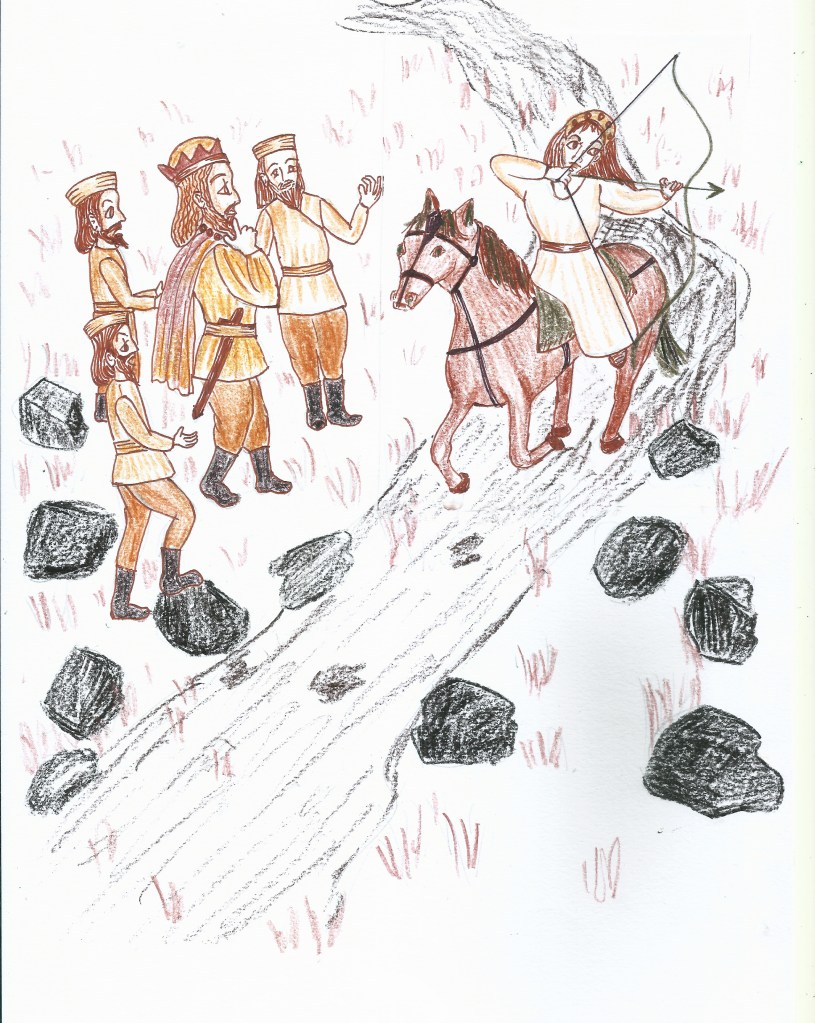
At the king’s request Gordiyeh displayed her skills in horse riding and wielding various weapons like spears, swords, mace and bow-arrows. The king was highly impressed.

Gordiyeh displaying her skills by shooting an arrow from a running horse. King Khushru is watching. Illustration by: Mrs. Katie Bagli.

However, queen Shirin cautioned the king, saying “Beware of this woman. She would become dangerous, the day the thought of avenging her brother comes to her mind.” The king laughed off the remark and told her that he was confident that she would always be friendly. After showing off her warrior like body and skills, the king asked her whether she was able to drink wine like a warrior. He offered her a large cup of wine, which she drank in one gulp without batting an eyelid. The king was amazed. Immediately, the king appointed her as the overseer of his personal bodyguards and the bodyguards of the harem.

To be continued………

SSS 28. King Khushru Parviz – Khushru / Cosroe II (591-628) (Part 5)

Behram and Makātureh in China

Behram Chobin went to China to seek refuge and help from its king. The Khakan of China kept him as his guest. Both became very friendly and spent considerable time together, playing games and going on hunts.

Once Behram noticed that a Turk by the name Makātureh, came to the king every morning, both of them talked secretly and he gave him one thousand Dinār every day. Behram was perturbed by this behavior and asked the king. The king said that he was a very powerful warrior and controlled a large part of his army. He was daily asking him for money and threatening to withdraw his support, if he did not.

Behram said, “This is not at all fair. If you permit me I can save you from him, but you will have to do as I say.” The king agreed.

Then Behram told the Khakan, “When the Turk comes to you the following morning, do not be nice to him and don’t even look at him.”

The following day when the Turk came, the Chinese king acted as instructed by Behram. The Turk was furious. He abused Behram for instigating the king and challenged him to an archery duel the following day.

The two warriors met at a pre-determined place for a duel. The king and several courtiers gathered to see the two mighty warriors fight it out. In the duel, Makātureh lost his life. The king was relieved that he was relieved from a person who was constantly harassing him. He handsomely rewarded Behram.

Behram and Shirkappi

A dangerous animal referred to as Shirkappi once emerged in the jungles of China. It was black in colour, bigger than a horse, and had two long horns. It was connected to the species of Azdah, since it too breathed fire.

The beast had taken away many young men and women. One day, when the Chinese princess had gone out with her friends, she too was taken away by Shirkappi. The queen was very distraught. She had heard about the heroic adventures of Behram, so she asked the king to request him to get back their daughter from Shirkappi.

Behram prepared himself and went to Shirkappi’s hideout. On seeing him, the ugly monster hid in the water. Behram waited for it to emerge from the water. After some time Shirkappi came out and went towards Behram to attack him. Behram shot three arrows which struck the beast, but it still had strength. Then Behram went up a mound and shot a spear at it, which fell the monster to the ground. Behram came down and cut the monster into two with his sword. He brought back the princess and returned her to her parents.

The king and queen were very happy, and so was the whole of China. The king lavished Behram with gifts and jewels. He also made him marry his daughter, so that he may continue to stay in China. He gifted him the province of Tartary and made him its ruler.

Khushru confronts the Khakan

When King Khushru came to know of the prominent position given to Behram Chobin in the Chinese kingdom, he immediately took affront and wrote a letter to the king. He said that Behram was a rebel, and a usurper of the Iranian throne. He reminded the Chinese king that he himself had been badly humiliated by Behram in the past, and so elevating him in his court, will tarnish his name, and also make him look weak.

He ended by saying that giving Behram an eminent place in the Chinese court was akin to a challenge to the Iranian king. He asked the Khakan of China to arrest Behram and send him to Iran or else he will retaliate with an attack.

The Chinese king replied that he had held Behram’s hand in friendship, and he will not leave it now, or else it would ruin his reputation. On reading the letter, Khushru consulted his ministers and sent another letter to China.

When Behram came to know about the letter from Khushru, he was furious and asked the Khakan to attack Iran. The king consulted his ministers, and they agreed with Behram. The king selected two eminent warriors Chinui and Zangui, and sent them with Behram to attack Iran.

When king Khushru came to know that the Chinese king has decided to send an army with Behram, he sent Kharrād to China to negotiate with the Khakan. Kharrād was well received. He stayed there for a few days looking for an opportunity to talk to the king about Behram. One day, when he got an opportunity, he warned the Khakan about Behram, and asked him to hand over Behram to the Iranian king. The Khakan was not in favour of doing this, as that would amount to breaking his promise with Behram.

Kharrād realized that he would not be able to persuade the Khakan, so he changed his strategy. Continued……

SSS 27. King Khushru Parviz – Khushru / Cosroe II (591-628) (Part 4)

Behram fights Khushru

The armies requested by the Kaisar for Khushru arrived. He added one lakh of his own soldiers and along with a lot of wealth, weapons, gifts and servants, sent it to Khushru. Along with that, he also sent Maryam, one of his princesses, as a queen for Khushru. Then he asked his brother Neyātus to lead the army to Khushru.

Neyātus met Khushru, along with the army. Maryam was presented to Khushru and he spent three days with her. Then he prepared to move towards Azarbaizan to go to Iran. He made Neyātus the commander of his army. On the way, he met Bandui and his friend Mausil who offered Khushru his army. The army of Nimruz also joined him.

When Behram Chobin came to know of Khushru advancing with the army, he prepared letters for Khushru’s commanders Gastaham, Bandui, Gordui, Shapur and Andiyān asking them to desert Khushru and come into his fold. He sent the letters with Dārā-panāh, one of his commanders.

When Dārā-panah reached Khushru’s army, he was awe-struck by its size and might. He and his commander Behram had expected something very small. Dārā-panāh did not like the betrayal, and he decided to go straight to Khushru and give the letters to him.

Khushru went through the letters and consulted his commanders. Together they decided to beat Behram in his own game, and prepared a reply, as if it was jointly written by the commanders. In the reply, Behram was informed that they would remain on Khushru’s side but fight for him against the Roman army. When Behram received this letter he was very happy.

Behram asked his commanders Yalān-sineh and Yazad-goshasp to prepare the army to attack Khushru. When the commanders approached Khushru’s army, they were over-whelmed by its sheer size. The combined army of Khushru was ready to take them on.

A Roman warrior by the name Kut asked Khushru whether he could go and fight Behram. Khushru allowed him to go. Kut was very easily defeated and killed, and so were many other Roman warriors, who went one after the other. Now, Khushru decided to send his Iranian army to fight Behram.

In the war, Khushru’s army met Behram’s army. Behram was on a white elephant. The Iranian warriors wounded the elephant, but Behram continued fighting on horse-back. He wreaked havoc in the enemy folds.  Khushru first wanted to himself go and fight Behram, but his warriors stopped him from doing that.

Sarosh Yazad to the rescue

Khushru’s warriors went to fight Behram. First Yalān-sineh and Azar-goshasp went, but both of them were defeated. Then Behram saw Khushru and followed him. Khushru started fleeing on his horse, but he soon realized that he had reached a dead end and there was no way he could escape. Just then, out of nowhere, a divine figure dressed in green, riding a white stallion, appeared before him.

The divine figure gently picked up Khushru and placed him in a safe place. A relieved Khushru could not control his tears at being saved from near death. He asked the figure, “Pray, tell me, who are you?”

The divine figure replied, “I am Sarosh Yazad. You will soon become the emperor of Iran. You are honest and divine. Never lose your piety.” So saying he disappeared from view.

Just then, Behram approached the place and saw Khsuhru talking to a divine figure. In exasperation, he exclaimed, “Uptil now, I was successful, as I had to just contend with humans. Now that I have to contend also with divine beings, I don’t think I could succeed.”

Neyātus and Maryam had seen Khushru being chased by Behram in the dead end. They were almost certain about his imminent death. Just then they saw Khushru coming from the other side of the mountain. They were shocked and surprised. Khushru narrated the whole incidence to his soldiers, and the entire army rejoiced. Now Khushru was confident that he will be able to regain his empire.

Behram Chobin defeated

On the following day, when the war resumed, Behram tried to attack an unprepared Khushru, but he missed his mark. Khushru then followed Behram. The Iranian army was motivated by their king’s bravery. They followed Behram’s army which had started retreating.

Khushru announced that whoever decides to surrender should be pardoned. Many of Behram’s commanders and soldiers surrendered. When Behram became aware of this, he collected some treasures and fled.

Khushru sent Neyātus to follow Behram. The two met in a bamboo forest and fought each other. Neyātus was defeated and he pleaded for his life. Behram spared his life and asked him to go to Khushru and tell him that he had spared him. From there Behram proceeded towards Rae, from where he went to China. Now the coast was clear for Khushru to re-occupy his throne.

Khushru re-occupies the throne

Khushru entered Ctesiphon in 591 CE and re-occupied the throne. He sent a letter to the Kaisar informing him about the developments. The Kaisar was very happy. In a return letter he praised him, and with it sent some clothes, ornaments, a jewel studded cross and wealth. When Khushru received this he was not sure whether to wear the rich clothes, as there was a cross on each clothe and he would run the risk of being called a Christian.

His minister however told him that by wearing the clothes he would not become a Christian, as he was a staunch Zoroastrian at heart. So Khushru wore the clothes. On seeing him, some of his courtiers understood that he had done this just to please the Kaisar, but others accused him for sympathizing with Christians and Christianity.

Khushru’s difficult task

After Khushru ascended the throne, he had the difficult responsibility to keep both the Zoroastrians and the Christians happy in his court. One day when Khushru was having food and drinks with his courtiers, he had worn the robes with the cross, presented to him by the Kaisar. The courtiers were not happy with this.

Once, when Khushru was praying the bāj before food, holding a barsom in his left hand, Neyātus stood up and shouted at the king, accusing him of insulting Christ by wearing a cross and doing Zoroastrian prayers and rituals.  This attitude angered Bandui, and he immediately stood up and slapped Neyātus.

A furious Neyātus stormed out of the court and sent a message to the king that he immediately wanted him to hand over Bandui to him or he would attack. Khushru was distressed at Neyātus’ behavior. He realized that this man could endanger the good relationship he shared with the Romans.

Just then Maryam approached the king and requested that she be allowed to play the mediator and pacify Neyātus, who was her paternal uncle. She went to him with Bandui and calmed him down. The Roman realized his mistake and there was reconciliation.

Khushru then sent Neyātus and the Roman soldiers back to Rome with lots of presents. He rewarded his faithful warriors Bandui, Gastaham, Burz-meher, Ram-barzin, Shapur, Andiyān, Gordui and Bālui by giving them lordship over provinces. He made Tokhāre the treasurer and Kharrade the Commander-in-chief of the armies. He handsomely rewarded all advisors and soldiers who had remained faithful to him.

SSS 26. King Khushru Parviz – Khushru / Cosroe II (591-628) (Part 3)

Kaisar agrees to help

The Kaisar sent Khushru a letter indicating his willingness to help him. He requested him to wait till he gathered the required army. The Kaisar also wrote that he was happy that Khushru trusted him enough to come to him for help, and did not go to anybody else. He then dispatched the letter.

However, the Kaisar’s advisory team had second thoughts. They did a turnaround and told the Kaizar that it would not be advisable to help the Iranians, as they were past enemies. They feared that after regaining power, Khushru may once again demand taxes from them.

The Kaisar sent an envoy to Khushru with a second letter, asking him to ignore his first letter. In the second letter it was stated that he would not be able to help him as his advisors feared repercussions.

Khushru wrote back to him, assuring that these were things of the past and nothing like this would happen in future. He also stated that if the Kaisar was not willing to help, he would leave Rome and approach the king of China. He dispatched the letter with his warrior Tokhār to the Kaisar.

When the Kaisar received the letter, he was confused, so he called the astrologers. They referred to astrological books written by Plato and said that fate has decreed Khushru as the next king of Iran who would rule for thirty-eight years, and will maintain cordial relations with him. When the Kaisar heard this, he agreed to help Khushru, on certain conditions.

The Kaisar wrote a letter to the Iranian king, in which he put down the conditions. One that he will have to sign a treaty of friendship, second that he would surrender parts of Armenia, Mesopotamia and the fortress of Dara, third that he will let go of all taxes and fourth that he will have to marry his daughter Mariam so that the two countries would be united by their child.

The letter was dispatched and read out. Khushru wrote back to the Kaisar agreeing to all the conditions. He asked the Kaisar to send his daughter along with his courtiers, and he will accept her as his queen. 

Tested by the statue

When the couriers and warriors of Khushru, reached the Roman court, the Kaisar wanted to test their intelligence. He made his craftsmen prepare a mechanical statue of a very beautiful crying lady, surrounded by maids. Then he summoned the Iranian warrior Gastaham and told him that sitting in the corner was one of his princesses who was very sad as her husband had passed away. He requested him to go and console her.

Gastaham fell for the ploy. He did not recognise the statue and actually mistook it to be a real lady. The mechanical statue bowed down to him and started shedding tears. Gastaham consoled the statue for quite a long time but it did not respond. Finally he went to the Kaisar expressing his inability to convince the princess.

Then the Kaisar summoned the Iranian warriors Bālui, Andiyān and Shahpur in succession, told them the same story, and asked them to console the princess. They too tried to console the statue mistaking it for the princess, and returned unsuccessful.

Finally the Kaisar called Kharrād and asked him to console the statue. He went to the statue and started talking. When he did not get any response, he realized that something was amiss. He noticed that the maids were still and not uttering a word. He also realized that her ‘tears’ were falling exactly at the same place, and she never moved except when she ‘bowed’ in the beginning.

The wise warrior Kharrād realized that the Kaisar was making a fool of the Iranian courtiers and warriors. He told the Kaisar that the lady was not real, but it was a mechanical statue. The Kaisar was impressed by him and told him that he was the wisest of all and he would recommend to Khushru to make him his minister. Then Kharrād was asked to explain to the Kaisar the differences between the Indian, Zoroastrian and Christian religions.

SSS 25. King Khushru Parviz – Khushru / Cosroe II (591-628) – Part 2

Behram attacks, Khushru flees

Behram’s sister tried to bring sense in him. She said, “Dear brother, do you know why Sam, Zal and Rustom never tried to occupy the throne, though they had so many chances. It was because they were wise and knew that this throne belongs only to those who have the divine glory of the royalty, those who are destined for it through lineage. Please drop the idea of occupying the throne of Iran, or it will bring you nothing but destruction.”

Behram agreed with her, but said, “Sister, I have come too far now to be able to retreat, even if I wanted to. Now it is either death or the throne.”

Khushru prepared for a Shab-e-khun “attack at night”, but Behram got this information through his spies, and he attacked first. Khushru’s army was badly defeated. The king’s advisors asked him to escape with some wealth and a few soldiers, since if something happened to him there would be no successor to the Iranian throne. Khushru agreed and did accordingly.

Behram saw Khushru while he was fleeing, and caught up with him. They had a brief duel, but Khushru managed to escape. Behram tried to follow him, but Khushru slowed Behram down by shooting an arrow at Behram’s horse. Meanwhile Khushru crossed the bridge of Naharavān and got it broken by the time Behram arrived. So when Behram arrived, he could no longer pursue Khushru and hence he went back to Ctesiphon.

The fleeing Khushru then went to his imprisoned father, seeking his advice. The blind Hormazd advised him to go to Rome and seek the help for finance and army from the Kaizar. As soon as Khushru left his father, Gastaham and Bandui took the life of Hormazd, fled from the palace and caught up with Khushru. Behram came into the capital, and entered the palace, and sent an army of six thousand soldiers to capture Khushru.

Bandui’s sacrifice

At night Khushru reached a Christian rest-house in the jungle where he sought refuge and food. The Bishop very kindly gave him food and wine and allowed him to rest there with Gastaham and Bandui. They had meal after taking bāj, holding the barsom in their hand.

Just as they were about to retire for the night, the chief Bishop came huffing and announced, “I see clouds of dust in the distance, behind which an army is advancing.”

Khushru was terrified at this news as his army was fatigued and in no condition to go any further. He beseeched Bandui, “O my well-wisher, I have run out of plans, now you will have to do something.”

A very somber Bandui declared, “In the present conditions there is only one plan I can think of, and that is to sacrifice myself to save you.”

A grateful Khushru, told him, “If you sacrifice yourself for me now, you will surely go to heaven. Anyways, we all may die if we do nothing. But by your sacrifice you may at least save the king. Do tell me your life-saving plan.”

“We both are almost of the same height and body,” Bandui explained. “I will wear your royal clothes, fool the enemy from a distance. They will think that you are standing here, and thus I can keep them waiting for some time. In the meantime, you will immediately flee with a few soldiers to Rome, as I hold the enemy up for a couple of days by my trick. When they find that they were tricked, I may most certainly lose my life, but I will die happy, that I was able to save my king.” A grateful Khushru, thanked Bandui for this supreme sacrifice and immediately escaped to Rome. Bandui then asked the Christian priests to leave the place and go somewhere safe.

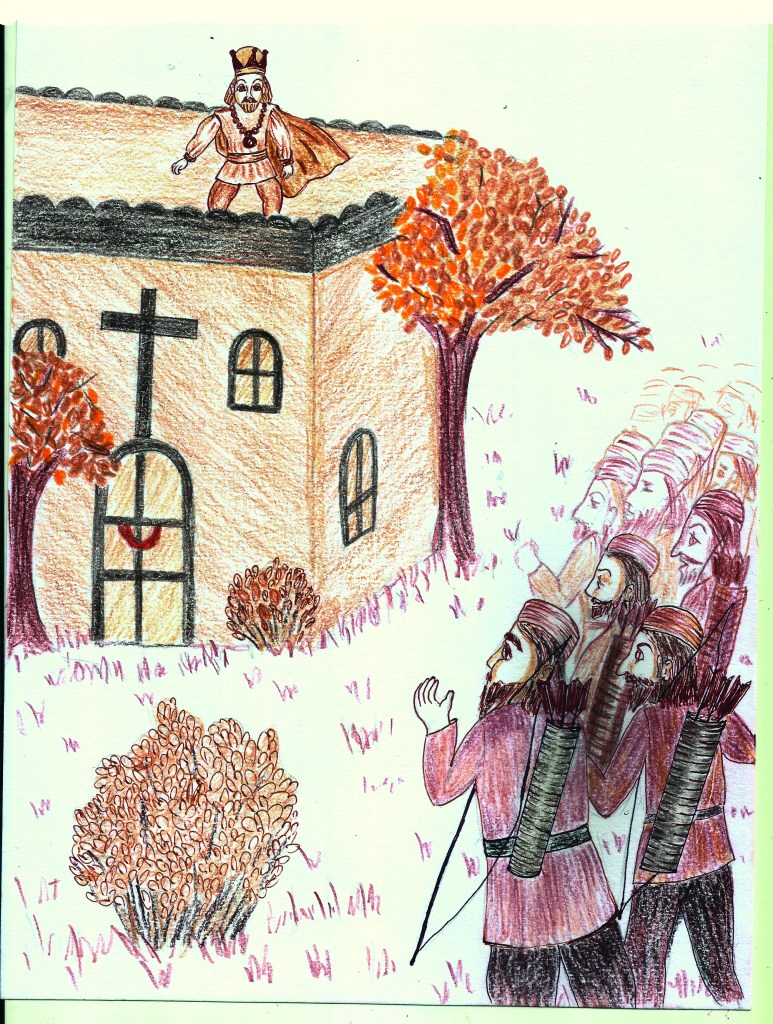
Bandui wearing King’s clothes, crown and jewels stood on the terrace of the Christian rest-house.

The enemy soldiers look at him from down at a distance. (Illustration by Mrs. Katie Bagli)

Bandui then wore the King’s clothes, crown and jewels and stood on the terrace of the Christian rest-house. Behram’s army came considerably near to see him, but not near enough to make out his face. The enemy soldiers mistook him for the king and started shouting in joy.  Bandui was assured that his trick had succeeded. He rushed down changed to his normal clothes and again went up to the terrace of the rest-house.

First he asked the soldiers for their leader. Behram, son of Siyavakhsh, came forward. Addressing him, Bandui said, “Tell your commander that our king is very tired and wants to rest for now. He will surrender himself to you tomorrow morning.” The leader agreed and they stayed on for the night outside the building.”

The next morning, the army was awaiting Khushru’s surrender, but he did not turn up. They were getting impatient as the sun had already gone up. Bandui once again went on the terrace and told them, “Our king could not sleep yesterday night as he was praying. Now he is resting. Since the sun has already gone up, he has decided that we should proceed tomorrow morning.”

Behram, son of Siyavaksh was not sure what to do. He feared that if he forced the king, he may want to fight, for which they were not prepared, and which may also anger their commander Behram Chobin. Hence, he decided to wait for one more day.

Khushru on his way to Rome

The next morning Bandui went up to the terraced and announced to Behram-e-Siyavaksh and his army waiting down, “Our king Khushru had fled to Rome two days back, and may have already reached there safely. Now you have two choices. You may either fight with me and I will fight till the last breath of my life, or take me as a prisoner to your Commander Behram, where I will answer all his questions.”

A flabbergasted Behram-e-Siyavaksh was completely floored by the trick. Hethought for some time and decided to take Bandui as a prisoner to Behram Chobin.

When Behram-e-Siyavaksh reached Behram Chobin with Bandui, he was very angry on both of them. He ordered Bandui to be imprisoned for the time being. He decided to deal with him very strictly later on.

Behram Chobin occupies the throne

Behram Chobin called a conference of the senior courtiers and staked his claim for the throne. The courtiers agreed to have him as the king, considering that he had saved Iran from the Chinese king Saveh. Most senior courtiers like Sheran-gurāz, Farrokhzād and Sambāz spoke in his favour and pledged their allegiance to him, even if Khushru were to return.

However a few courtiers, like Khushru the ruler of Kharzvan, maintained that Behram Chobin had no right to occupy the throne as he did not belong to the royal family. He said, “Even a lady of the royal family is preferable as a ruler than the bravest warrior who does not belong to the royal family.”

There was a danger of tension erupting in the court among the two groups, as members of both the groups drew their swords. Behram Chobin intervened and warned that nobody should use the sword or he will severely punish them. Annoyed, he left the court.

The next day he occupied the throne and issued a decree announcing himself the king of Iran, and henceforth only his family members would be entitled to the throne. He took the signatures of all courtiers who accepted him as the king, and to those courtiers who did not sign, he gave a period of three days to leave Iran and go to their king Khushru in Rome.

Bandui escapes

In prison, Bandui befriended Behram-e-Siyavaksh who was his guard. He convinced him that Behram Chobin will soon lose his throne, since Khushru will attack him with a big army from Rome. He assured him of pardon and a good position once Khushru became the king.

Bandui not only convinced Behram-e-Siyavakhsh to free him, but also to kill Behram Chobin, when he was outside, playing the game of Chogan-gui. However, the wife of Behram-e-Siyavakhsh was a big admirer of Behram Chobin, and she warned him of her husband’s plan. Immediately Behram apprehended Behram-e-Siyavakhsh when he came on the play-ground and killed him.

Then Behram Chobin instructed his trusted man Māhrui to be Bandui’s guard. To their dismay, they realised that he had already fled. It was then, that Behram Chobin realized that it was Bandui who had misled Behram-e-Siyavakhsh. He regretted killing his trusted commander in hurry.

On the other hand Bandui, with a few trusted soldiers of Behram-e-Siyavakhsh, fled towards Ardabil. On the way in the jungles, he met an Armenian by the name Mausil and befriended him.

Khushru Parviz reaches Rome

Khushru fled non-stop towards Rome. On the way, he was warned him that the soldiers of Behram Chobin were following him. A tired and hungry Khushru reached the Euphrates river where a kind Arab leader by the name of Kaius-e-Hāres gave him food and place to rest. On the way he met a kind man by the name Kharrād-e-Barzin who also gave him food and became his guide. From then on he became a trusted advisor.

Khushru reached Rome in 590 CE after passing through many villages and cities. On the way he met a very old priest in a Church, who was a renowned astronomer. The priest predicted that Khushru would get back his throne back in a year with the help of the Roman Emperor, that he would marry his daughter and thereafter he would have a very happy life. He was also told that he would have to beware of his uncle Bestam.

Now, Khushru knew that the real name of his uncle Gastaham was Bestam, so he summoned him and told him of the prophecy. Gastaham pledged that he will never do anything to betray his trust. The, he went further and stopped in the city of Hierapolis, and stayed there with some priests in a Church for three days.

When the Roman Kaisar Maurice (582-602) came to know of Khushru’s presence in Rome, he conveyed a message to him assuring him all possible help. Khushru in return sent his best warriors Bāluy, Shapur, Kharrad and Andiyān to the Kaisar at Constantinople, under the leadership of Gastaham, with the message seeking help of the Kaisar in over-throwing the rebel king Behram Chobin.

(Part 3……to be continued)

SSS 24. King Khushru Parviz – Khushru / Cosroe II (591-628) (Part 1)

Hormazd IV had a son called Khushru who was very dear to him. However, he had a strict upbringing. Later the son came to be known as Khushru Parviz.

Behram poisons the king about prince Khushru

Behram Chobin, Hormazd IV’s commander who had become a rebel, devised a wicked plan to poison the mind of king against his son Khushru. He issued coins in the name of prince Khushru and asked his people to circulate it in such a way that they come to the attention of king Hormazd, who would then think that his son has become rebellious and is challenging him.

Thereafter Behram informed the king that his son was planning to overthrow him. He also mentioned that he personally would prefer Khushru Parviz as a king, and that he would be faithful to the son but not to the father. 

Behram was hoping that king Hormazd would start doubting Khushru Parviz, and perhaps have him killed, which would pave his way to defeat and overthrow the ageing king Hormazd and takeover the throne of Iran.

As Behram had schemed, his devious plan had the desired effect. On seeing the coins, Hormazd IV was furious at his son Khushru. Without asking his side of the story, the king jumped to the conclusion that his son was planning a rebellion. He asked his advisor Ain-Goshasp to have his own son Khushru killed.

Khushru flees for his life

One of the king’s guards of the king, who had overheard the conversation, was a well-wisher of Khushru. He went to the prince and cautioned him about the plan hatched to take his life. Khushru immediately fled the palace and went to Azarbaizan. When the courtiers and commanders came to know of this, they were disgusted with the king.

Some of the courtiers like Bādān, Piroz, Pilzor, Estāy, Khanjast, Sam and Asfandyar went to Khushru and pledged their support to him. They assured him that they will fight in his favour if the king tried to do anything to him. They went and took an oath at the Atash-kadeh of Azar Goshasp to always be loyal to the prince.

When the king came to know about the prince’s escape and the courtiers defecting to his side, he became very angry. He imprisoned Khushru’s maternal uncles Gastaham, Bandui and some other relatives, suspecting them of complicity in his escape.

King Hormazd was extremely heart-broken. On the one hand he feared Behram and on the other hand he was anxious about Khushru. He stopped going to court and lost interest in life. News about this spread all around.

Taking advantage of the anarchy, maternal uncles Gastaham and Bandui, broke out from the prison and led a revolt against the king in order to get Khushru on the throne. They stormed into the palace, and snatched the crown of king Hormazd. Instead of killing him, they blinded him and left him writhing in pain. When Khushru received the news of his father’s deposition, he was saddened as he did like his father, and had always been willing to serve him. People had created misunderstanding between them and so he had to flee in order to save his life. Gastaham asked him to come back to Iran and rightfully claim his throne.

In 590, Khushru reached the capital and occupied the throne. At night he went to see his father and cried his heart out on seeing his plight.

“Father”, he said, “Why did you not trust me? If I was with you, none would have dared to harm you. Even now I want you to be the king, and serve you.”

The father realized his mistake, but it was too late.

He told his son, “Now we are good at places where we are. I just ask for three things from you.  First, every morning come to meet and greet me, even for a short time. Second, send an old courtier or commander to talk to me, read to me and spend time with me, and third blind your two maternal uncles who have blinded me.”

Khushru agreed to the first two, but about the third wish, he said, “Father now the time is not right to punish my uncles, as now we have to focus towards fighting Behram Chobin.” So saying the dutiful son bid his grieving father a tearful farewell.

Behram meets Khushru

When Behram came to know that king Hormazd was blinded and imprisoned, and that Khushru had taken the throne, he took the opportunity to attack and overthrow the new king.

When Khushru came to know of this, he sent spies to Behram’s camp to ascertain the strength of his army. The spies returned with a very positive review about Behram, that he was a wonderful commander, he communicated well with his soldiers and always based his opinions on first-hand information, rather than on hearsay or other’s advice. Moreover, he was a voracious reader, had read most books on wisdom and always kept books as his companions and advisors.

Khushru was impressed by Behram’s good qualities. He desired to have him as his advisor, and hence he would offer him truce. Khushru had never met or seen Behram before. He went to Behram’s camp and asked one of his commanders to identify him from a distance. When Khushru saw Behram on his black horse, he realized that he was quite ugly, and hunchbacked.

Khushru, on his white horse, went to meet Behram, asked for truce and offered him commandership of the army. Behram declined the offer. They talked at length about blaming each other for their faults and being ungrateful to their benefactors. Then the two went their way.(To be continued…….)