
SSS 34. King Khushru Parviz – Khushru / Cosroe II (591-628) (Part 11-last)

Khushru’s trap for Shahrbarāz

In the later days of his reign, two of Khushru’s commanders, Shahrbarāz and Farrokhzād (also known as Gorāze and Farāin) betrayed him. Of the two, Shahrbarāz plotted against him by defecting to the Kaisar and asking him to attack. Khushru found out about the betrayal, conferred with his cabinet and planned to trap Shahrbarāz at his own game.

As the first part of his plan, he summoned Shahrbarāz, and told him that he had come to know about his message to the Kaisar, in order to trap the Roman king. He thanked him for asking the Kaisar to attack so that they can surround him. He then told him, “We will trap him with armies from both the sides, you come from one side and I will come from the other.” Shahrbarāz thought that he had been able to fool Khushru.

As the second part of his plan, Khushru sent a letter tied to an arm of the messenger. The messenger was specifically asked to get caught at the hands of the Roman soldiers. When asked, the messenger had to say that he was carrying this letter from king Khushru to Shahrbarāz. If they grabbed the letter, he should allow them to grab it.

It exactly happened as planned, the messenger was caught and taken to the Kaisar. The letter was found on him which was read out by the Kaisar. The letter congratulated Shahrbarāz for his plan to trap the Kaisar. The Roman emperor was shocked at seeing the letter and was furious at Shahrbarāz for trying to trap him. He told his ministers that Shahrbarāz had tricked him and Khushru was awaiting them with a three lakh strong army. The Kaisar decided to withdraw his army.

When Shahrbarāz came to know that the Kaisar was not sending his troops, he was terrified. He wrote back to Kaisar asking him the reason for his withdrawal. The Kaisar replied that he had caught Shahrbarāz’s lies and that he has come to know that the Iranian commander had wanted to trap him and get him defeated at the hands of Khushru. Shahrbarāz tried hard to convince the Kaisar that this was not the case, but it was in vain.

A rebellion against Khushru

In order to trap Shahrbaraz further, Khushru sent a letter to Shahrbarāz, telling him that he had come to know that a part of his army was unfaithful to him and inclined towards the Kaisar. He asked Shahrbarāz to send him those soldiers, so that he can punish them.

Shahrbarāz, afraid of the wrath of the king, sent innocent soldiers to Khushru, along with Farrokhzād. When the king asked about their betrayal, the faithful troop denied having any connection with Kaisar, but the king insisted that if they did not confess he would punish them all.

Shiroy in house arrest

Prince Shiroy, the son of Queen Maryam, started growing up. As a child, his interests were not normal. Instead of playing with regular toys, he was always interested in playing with unusual and frightening things like paw of wolves and horns of cattle. These made the courtiers doubt his nature and temperament. When Khushru was informed about this, he instructed his courtiers to keep an eye on the prince, especially because, at the time of Shiroy’s birth it was predicted that he would be harmful to the Iranian nation. It was decided to keep the prince and his immediate family under house arrest, with forty soldiers keeping an eye on them.

Prince Shiroy grew up to be a youth of sixteen, spending most of his time under house arrest. The clergy and the nobility favoured Shiroy as the heir apparent and successor of the king, However king Khushru preferred his other son Mardānshah to succeed him.

Farrokhzād, the troop’s leader was unhappy at the king’s attitude. He and the troop decided that they should seek a new king, preferably one among the sixteen princes. The rebel prince Shiroy seemed to be the best choice, but he was in the prison.

Farrokhzād then went to commander Tokhār and sought his help. Tokhār too had become dissatisfied by Khushru’s oppressive ways. They joined hands and went to the place where Shiroy was kept under house arrest. On seeing them Shiroy was surprised. When asked to rebel against the king, at first he was hesitant, but then he agreed. They told Shiroy that now onwards they will use his official name Kobad.

At night, the rebels stormed into the prison. First they took the soldiers and commanders on their side and then they went into Khushru’s bed chambers, shouting slogans of “Long live Kobad”. Queen Shirin was shocked on hearing the noise, and woke up Khushru.

A dazed Khushru, when he heard the name of Kobad in the middle of the night, immediately realized that the predictions regarding Shiroy had come true. He decided to flee eastwards to save his life. He donned his armour, took his sword, went out and hid in the garden.

Khushru is caught by the rebels

Khushru spent the whole night in the garden waiting for an opportunity to run out of the palace. However, he could not move out till noon the following day. As he was feeling hungry, he called a gardener who was not able to recognize him, gave him some jewels from his bejeweled cummerbund (waist belt) and asked him to get some food.

Gardener with jewels at Baker’s shop. (Illustration by Mrs. Katie Bagli)

The gardener went to the baker who had never seen such precious jewels before, nor had the change to give back. So he took him to the jeweler. The jeweler immediately recognized the precious jewels he had sold the king and thought that the gardener had stolen them. So he took both of them to Farrokhzād. Farrokhzād, took the three of them to Shiroy, who asked the gardener about the jewels. The gardener told him the circumstances in which he had got them. He described Khushru and his dress. Shiroy immediately realized that this person was none but king Khushru. He sent a troop of three hundred soldiers to capture the king, and he was later imprisoned at Ctesiphon. Shiroy, that is, Kobad II ascended the throne.
SSS 33. King Khushru Parviz – Khushru / Cosroe II (591-628) (Part 10)

Story of Sargash and Bārbud

Khushru was in the twenty-eighth year of his reign, and there was peace in his kingdom. In the court of the king there was a very accomplished singer and musician by the name Sargash. When another musician by the name Bārbud came to know that the king wanted to choose a royal musician, he decided to go and try his luck in the king’s court.

When Sargash came to know that Bārbud was trying to enter the court, he bribed the guards and asked them to bar his entry. Bārbud tried several times but he was denied entry for one reason or the other.

Then Bārbud tried another strategy. He befriended the royal gardener and requested to grant him an entry in the king’s garden on the day on which the king was to come to entertain himself in the garden.

The gardener agreed, and he told Bārbud about the day when the king would spend the evening in the garden. On the appointed day Bārbud went into the garden early in the morning wearing a green dress. He painted himself green and coloured all his musical instruments like Sitar, Sarangi and Morchang in green. Early in the morning he hid himself on top of a Sarv (Cyprus) tree and waited for the king to come.

The king came in the evening and started sipping wine. Bārbud started playing rāg (musical mode) Dād-Āfrid. The king enjoyed his singing and music. The he played another song in the rāg Paykāre-Gord. The king was intrigued hearing the beautiful music and voice, and asked his soldier to find out who was playing the music and who was singing.

The soldiers searched everywhere but could not find Bārbud as he was hiding up in the tree. Then Bārbud started the third rāg called Sabz-dar-sabz, which was totally tantalizing and captivating. The king showered praises on this heavenly music. Hearing the praises, Bārbud came down and presented himself before the king. At the king’s behest, he narrated his tale of woe. The king was very angry at Sargash and appointed Bārbud as the court musician.

Opulence and oppression

Then Khushru Parviz had a magnificent palace built at Madāyān by a Roman architect, which took seven years to complete. In the palace, he had a magnificent throne made from carefully preserved parts of an ancient throne which was originally created during the time of Peshdadian king Faridun, destroyed later by Alexander and then once again rebuilt by Sasanian emperor Ardeshir Babegan.

When Khushru came in possession of this throne, he had it dismantled and made it once again, employing hundreds of craftsmen, goldsmiths and jewelers. On account of his opulent lifestyle, the treasury started depleting and hence Khushru started levying heavier tax thus leaving his subjects reeling under immense misery. He also became oppressive, and things got so bad that people started leaving the country.

SSS 32. King Khushru Parviz – Khushru / Cosroe II (591-628) (Part 9)

Khushru Parviz and Shirin

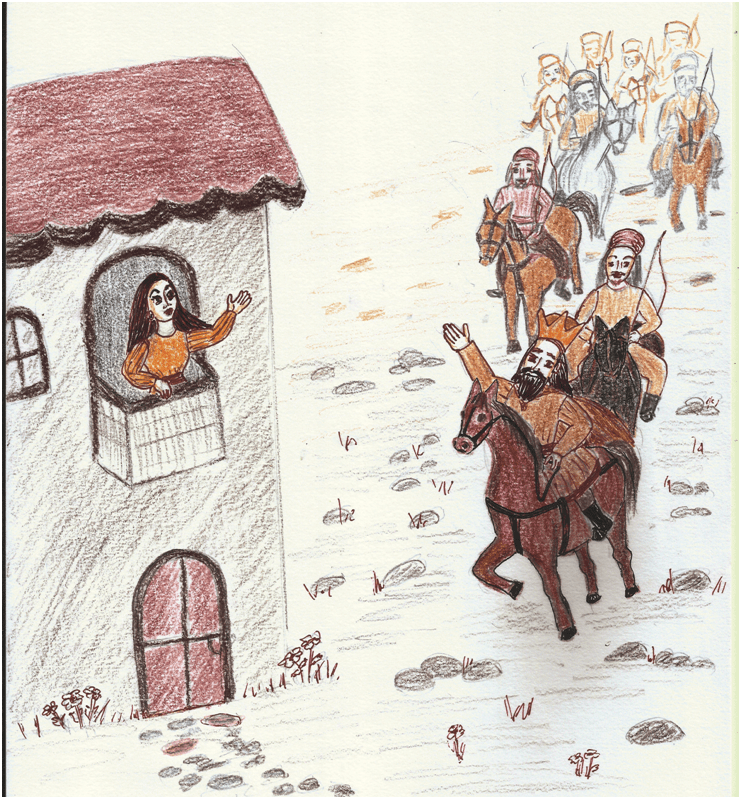
Khushru Parviz and Shirin knew each other from a very young age, and had tender feelings for each other, though Shirin was not from a royal family. Their friendship abruptly ended when Khushru had to leave Iran, to contend with Behram Chobin and then flee to Rome. The two got separated from each other for a long time, but none was able to forget the other. Years after they were separated, once when king Khushru had gone hunting, he passed through the city where Shirin stayed. When Shirin came to know of this, she was overjoyed. She got all dressed up and stood on the balcony of her house. When she saw Khushru, tears of joy started rolling out of her eyes and she cried out to him, reminding him of their past love. When Khushru heard her voice he looked up, saw her and his eyes too welled up with tears of joy.

Khushru stopped his entourage, met Shirin, and then asked his soldier’s to escort Shirin to the Queen’s palace. After returning from the hunt, he went to see her at the Queen’s palace, and the old love was rekindled. They were soon married.

The elders of the court were not happy with this development. They advised the king that marriage of a royalty with ladies from other social or religious strata always resulted in tragedy. They gave the examples of Zohak and Alexander. They requested Khushru not to make Shirin a part of his Queen’s palace. However, Khushru assured his courtiers that Shirin was nobly born, but her family had become poor on account of the vicissitudes of time.

Khushru’s prominence increased. On account of peace in the kingdom, the king spent more time in the Queen’s palace. Since Maryam was the chief queen, Khushru spent more time with her, which made Shirin jealous, as she had to spend long and lonely years all alone. It seems that it must be during this time that she may have developed soft feeling for Farhad (see story below). After some time, Maryam passed away and then Shirin was made the chief of the Queen’s palace, which had twelve thousand young maidens in it.

Shirin and Farhad

A story about queen Shirin, not mentioned in the Shahnameh, but popularized by poet Nizami in local tradition, is about her love with Khushru and then Farhad’s love for Shirin.

In this story, Shirin, an Armenian princess falls in love with prince Khushru and Khushru with princess Shirin, even without seeing each other, on the basis of their descriptions. Both set out to meet the other, Khushru going to Armenia and Shirin visiting Madayan. However fatefully their paths keep crossing several times, and they are were not able to meet. Finally, Shirin went back to Armenia, and Khushru returned to Madayan on account of his father’s death.

Then Khushru, chased out by Behram Chobin, went to Armenia and met Shirin, but Shirin did not agree to marry him till he claimed back the throne from Behram Chobin. Khushru left Shirin in Armenia and went to Rome to seek the Caesar’s help. The Caesar agreed to assist him on the condition that he marry his daughter Maryam, and not marry anybody else as long as Maryam was alive. With the help of Maurice, Khushru regained his throne. Maryam came to know about Shirin and Khushru’s past relationship and tried her best to Khushru away from Shirin. But fate had other choices, King Khushru met Shirin, married her and brought her to the queen’s palace, but Maryam kept the king away from Shirin, who started living a very lonely life in the palace.

Meanwhile, a court sculptor named Farhad, who specialized in carving sculptures for the king’s gardens, befriended Shirin, and in some time fell in love with her. Shirin also started to like Farhad. When the king came to know of this, he decided to break their alliance in a subtle manner. He set Farhad a difficult task in a far off place. He sent him off to the Behistun (Bisutun) stone Mountain with the near impossible tasks of carving a pathway for water from one side of the mountain to another for a garden, and finally preparing a huge bas-relief on the outer face of the Bisutun Mountain.

Farhad left off for Bisutun. In the hope of reuniting with Shirin he began his tasks in great earnest and quickly completed the first two tasks. The king was amazed at his ability.  Farhad then started flattening the lower outer face of the Bisutun mountain, his third task, and was about to start reilefs on it.

When king Khushru, realized that Farhad was nearing completion of the third task and about to return, as he had almost finished the three tasks, he started thinking of ways and means to keep Farhad away from Shirin. A devious thought crossed the king’s mind and he sent a messenger to Farhad with the false news of Shirin’s death. Farhad was distraught on hearing this false news, and his desire to live in a world devoid of Shirin vanished. He threw himself from the mountaintop and gave up his life. A relieved Khushru then informed Shirin of Farhad’s death. Soon after this, Shirin too passed away.

Today this unfinished flattened face of the Bisutun Mountain still exists. It is two hundred metres wide and thirty metres high, and is referred to as “Farhad-Taraash.”

SSS 31. King Khushru Parviz – Khushru / Cosroe II (591-628) (Part 8)

King Khushru Parviz and the Romans

For the first twelve years of his reign, Khushru remained committed to maintain his friendship and loyalty with Maurice. However after the Roman emperor’s violent death in 602 CE, Khushru not only refused to accept the authority of his successor Phocas who had assassinated Maurice and his family, but also Khushru gave refuge to Theodosius, the only surviving member of Maurice’s family.

The eight years of Phocas’ reign was a disaster for the Byzantine empire. The new emperor was unable to deal with the developments in the kingdom, especially the might of the Iranian army. So he offered truce, but his peace overtures were rejected, and Khushru initiated a war with Byzantine. Theodosius was a part of many Iranian campaigns.

Khushru emerged victorious on account of his might and power, his tactical prowess, and also because of the rampant internecine warfare and civil wars in then Byzantine empire. It is reported that at the battle of Arkhamus, Khushru put together a ‘moving fort’ of armored elephants with cabs housing archers, and achieved a crushing victory, capturing the fort of Dara.

Commander Shahrbaraz

Between 604 and 610, many fortresses were captured by the Sasanian commander Farrokh Shahrbaraz across Mesopotamia, Syria, Palestine, Anatolia, Armenia, Edessa and Egypt. Sasanian general Shahen cleared the Byzantines from Caucasus in 611, thrust into Cappadocia and captured it by 613.

The civil war of the Romans in Syria and Palestine led to the execution of Phocas. Heraclius was invited by the Roman senate to take over the helm of the empire. The new emperor ruled from 610 to 641. He made pleas to Khushru for peace, but the Iranian emperor, who was on a winning streak, rejected his overtures.

The Iranian commander Shahrbaraz crushed Heraclius and his brothers and annexed Cilicia to the Sasanian empire, followed by Damascus in 613 and Jerusalem in 614. The Jews in Jerusalem were liberated but the Christian population was treated very harshly, and their patriarch Zacharias was imprisoned. The ‘True Cross’ also known as ‘The Holy Cross’, the Cross on which Jesus Christ was crucified, was taken to Ctesiphon and placed in the care of Khushru’s queen Shirin.

In 615 Khushru’s forces captured Anatolia and Chalcedon, and were at the gates of Constantinople. Never since Cyrus and Darius had Persian cavalry traversed such distances. In geographical expanse, Khushru had recreated the empire of Darius the Great. During the Sasanian times, this was the largest western expanse that any king had occupied. The Sasanian emperor commanded all of western Asia with the exception of Constantinople.

Khushru’s military continued its westward advance unopposed. First it captured Sardis in 616. No Iranian king since Cyrus the Great had achieved this. Rhodes Island, Constantia and Samos too came under the Sasanian command, followed by Alexandria in 619. By 621, all of Egypt had shifted from Byzantine power and was now under Iranian occupation. This was the second time in Egypt’s history that it was part of the Iranian empire.

In 619 the Turks and Hephthalites struck in north eastern Iran, and came close to Isfahan and Rae. After a few setbacks, Khushru’s Armenian commander Bagratuni was able to kill their leader and squash their attack.

However, Khushru’s fortunes in wars started declining from 622 when Heraclius, with an army of zealous Christians, describing his attack as a religious crusade, attacked the Sasanians in Armenia and defeated Shahrbaraz.

In 624 Heraclius went into the heartland of the Sasanian empire. He sacked the sacred Adar Gushnasp fire temple at Shiz in retaliation of the taking of the ‘True Cross’ by Khushru in 614.

In 625, Heraclius arrived in Cappadocia and went to the Caucasus. Though at first he was defeated by the combined Sasanian forces of Generals Shahen, Shahrbaraz and Shahrapakan, he was later able to overpower them. Shahrbaraz managed to escape, but Shahrapakan was killed.

In 626, Heraclius was again victorious at Constantinople. He achieved his victory in an interesting manner by allegedly intercepting a letter written by Khushru to his other commander Kardarigan asking him to remove Shahrbaraz or have him killed. This was because, Khushru was now suspicious and insecure about Shahrbaraz’s growing might and stature. Heraclius somehow showed this letter to Shahrbaraz and gained his support. Without his powerful commander Shahrbaraz by his side, Khushru lost to Heraclius and had to sue for peace.

Now Heraclius and the Khazars joined hands. To further cement the alliance, Heraclius gave the hand of his daughter to the Khakan of the Khazars. It was difficult for Khushru with his depleting forces to stand up against their combined might.  In 627 they attacked and captured Albania and then moved south, but they were not successful in Armenia.

Khushru was finally defeated at Nineveh after a long drawn battle. Much of his elite infantry and cavalry was destroyed. The Iranian commander Rahzad (Razutis) also lost his life. Then the Romans proceeded to Khushru’s grand palace at Dastegard, looted the treasures and destroyed it in 628. Heraclius returned to Constantinople after destroying numerous other Sasanian palaces. Khushru ordered his remaining army to gather and guard Ctesiphon, where Heraclius was soon expected to arrive.

Shiroy is born to Queen Maryam

Now let us go back to the Shahnameh’s description of Khushru’s palace and palace intrigues. In the sixth year of the reign of king Khushru, Queen Maryam gave birth to a son. In those times, children born of nobility had two names. One was the private family name which the father uttered softly in the child’s ear, and the other the public name, which was announced aloud. The king uttered the child’s private name as Kobad in his ears, and the public name was announced as Shiroy.

When the astrologers were asked to foretell the events of Shiroy’s life, they gave a very grim prediction, saying that he will be harmful the country and its people. This greatly pained the king. His ministers consoled him as nobody could have power over the inevitability of fate. The king conveyed the tidings of the child’s arrival to its maternal grandfather, the Kaisar, who announced festivity in Rome. He sent lots of gifts for the child, his mother and the king. In a letter sent by the Kaisar, he requested Khushru to return the ‘True Cross’, which had been captured in a previous war. On receiving the letter, Khushru first thanked the Kaisar for his kind and generous words. However he declined to return the ‘True Cross’ as he feared that the Iranian people may regard such a gesture as a sign of him being favourable towards Christianity. He sent three hundred camel loads of presents to the Kaisar, which included ten camels laden with sacks of Dinars.