
Yazdezerd Sheheryar /Yazdezerd III (632 – 651)
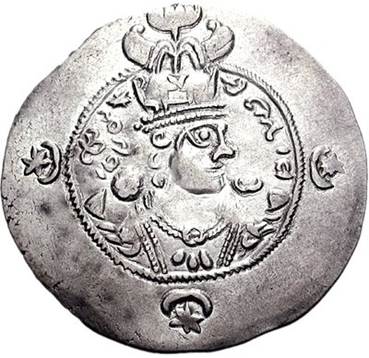
Yazdezerd III, also known as Yazdezard Sheheryar occupied the throne on 16th June 632, at a very young age of sixteen years. This was also the year in which Muhammad, the prophet of Islam, passed away.
Yazdezerd, the son of Sheheryar, and grandson of Khushru II, was discovered by the nobility at Istakhra. His true identity had been kept hidden, since Khushru II had forbidden his son Sheheryar to marry on account of a prediction that some day the Sasanian Empire would slip away from the hands of a child of Sheheryar. Moreover in the times of chaotic and deadly court politics following Khushru II’s death, it was not considered prudent to reveal the existence of a royalty.
The nobles and the clergy convinced the young and inexperienced Yazdezerd to assume the throne. He was crowned at Istakhra, which was still relatively safe from court intrigues. He proved to be a brave, courageous and good king, but was unfortunately the victim of tragic circumstances at the Iranian royal court.
Very soon, he was forced to move from province to province demanding loyalty, money and support from his allies and other provincial rulers. His reign was not peaceful and he was most of the times a ‘wandering monarch’.
Rise of the Arabs
The three decades of Persia-Byzantine wars during the time of Khushru Parviz had taken a terrible toll on the Iranian and Roman armies, and the Arabs were well aware of this. The Arabs had the added advantage of being united under the banner of Islam. They were fired up by the zeal of spreading Islam by waging wars. The first Caliph Abu-Bakar, who was stationed at Medina, organized the Arabs and declared it a Jihad to expand the boundaries of Islam. He made overtures to secure trade concessions and a tax free regime from the Iranians, which were rejected.
The Arabicisation of Iranian territories had started since 630, much before Yazdezerd came to the throne, when Sasanian governors of Yemen, Bahrain and Oman were forced out by the Arabs. The cities were taken over by the Arab Muslims. Zoroastrians were allowed to follow their religion only after paying tributes. Thus the Arabs extended their rule over the entire Arabian Peninsula.
Battle of Hira
In 633, Arab commander Mosni bin Haresa entered Hira in southern Mesopotamia (Iraq), thus making the first inroads into Iranian territory. This place was very decisive as it was the buffer between the Sasanians and the Arabs in the desert. The Arab commander was not able to sustain for long, as the brave Iranian commander Rustam Farrokh-zād, who was the son of king Hormazd IV, was able to defeat him.
In 634, Arab tribes under commander Mosenna (also known as Muthanna) again tried to make inroads into Hira. However, General Mehran, commander of the Iranian army, was able to scatter and oust them. Afterwards, Mosenna successfully gathered and united many more Muslim and Christian Arab tribes, and returned with a bigger army and reinforcements. He started looting, marauding and harassing the Iranians in and near Baghdad. To counter this menace, king Yazdezerd once again prepared and sent an army of twelve thousand soldiers under Commander Mehran.
There was a fierce battle at Hira where the Arab army had camped. Both the armies were badly depleted. The two commanders came face to face, in which Mehran lost his life. The Iranian soldiers retreated on hearing about their Commander’s death, and thus the Arabs inflicted a crushing defeat to the Iranians.
Mosenna went back to Medina. He convinced the dying Abu Bakar the need to provide more troops. He also made an impassioned speech to the Arab Moslems to shed their blood for the cause of their prophet and religion. His speech had the desired effect. More than a thousand new recruits joined, one of whom was Abu Ubeidah (or Obayad) who later took command of the Arab forces. Shortly, another army joined Mosenna from Medina. These combined forces charged against the Iranian army, which was not able to give a strong resistance.
Battle of the Bridge
In 635, the Arabs under Commander Abu Ubeidah came into Mesopotamia and crossed the Euphrates on a bridge of boats. Sasanian General Behman attacked them with elephants and cavalry. The elephants in the Sasanian army frightened the Arab horses, which refused to proceed. The Arabs mounted an attack on foot. However, they were not successful, as the bridge of boats started to set adrift. In the commotion that ensued, the Arab commander Ubeidah was trampled under the feet of a huge elephant.
Quickly enough, the Arabs started to make a new bridge. Arab commander Mosenna came to their rescue with a troop of ten thousand soldiers. The news of a rising at Ctesiphon compelled Iranian commander Behman to rush there. There was fierce fighting with much loss of life on both sides. Many Iranian soldiers were killed or were drowned. This was the last battle in which the Sasanians were comparatively more successful over the Arabs. Mosenna while retreating with a few soldiers, was seriously injured and died soon afterwards.
The developments from here led to the Battle of Qadesiya, one of the last decisive battle of the Sasanians….
 Ramiyar Karanjia