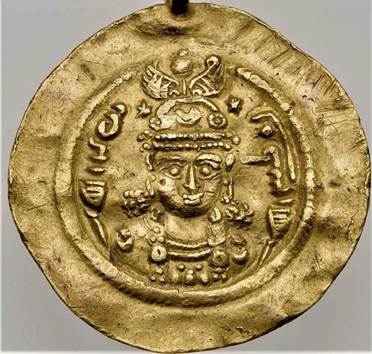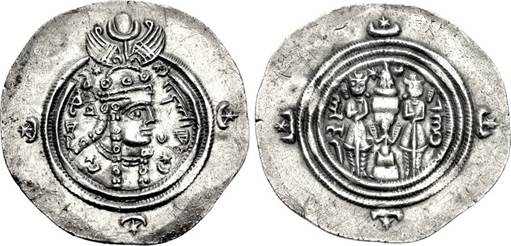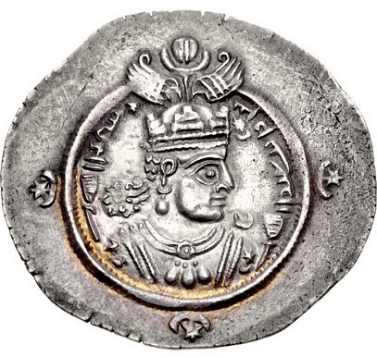
Shiroy, ruled for a brief period of ten months, after which his son Ardeshir was made the king at the young age of just seven years. Piruz-Khushru, a minister, was appointed his care-taker. The boy king assured his ministers of a just and peaceful reign. He appointed king Khushru’s son Firuz as the commander of the army.
When Shahrbarāz came to know about the death of both Khushru and Shiroy, he saw an opportunity to usurp the kingdom. He wrote to Firuz, the army’s commander to kill Ardeshir, and then he would be made the king. Firuz did not like this idea and declined. Then Shahrbarāz went to seek the help of the Roman king Heraclius, who readily obliged.
Firuz, however had second thoughts. He followed Shahrbarāz’s suggestion, and when King Ardeshir was alone, strangled him to death. The young king ruled only for six months. When Shahrbarāz got this news, he came with Heraclius and a huge army towards Ctesiphon, and announced himself the new king of Iran.
Shahrbarāz (Apr 629 to June 629)
Shahrbaraz on his coin
After assuming the throne, Shahrbarāz announced that he was starting a new dynasty and that after him his children will continue. Shahrbarāz had become close to Heraclius over a period of time, and is believed to have embraced Christianity. Such was the Roman influence, that he named his son Niketas and daughter Nike. He had his daughter Nike and grand-daughter Gregoria married to Heraclius’ sons Constantine and Theodosius. However, Shahrbarāz himself married an Iranian princess Āzar in a bid to attract the loyalty of the Iranian nobility.
Shahrbarāz was a military general and hence new to administration. He had never witnessed so much wealth and did not know how to manage the royal treasures. He splurged the money on wine, food and expensive golden, silver and jewel-studded utensils. He gave large and disproportionate amounts as gifts and awards to courtiers and soldiers. In a very short time, the royal treasury was almost empty.
He spent most of his time drinking, eating, merry-making and sleeping. At the smallest pretext he would mete out death penalties, sometimes even to innocent people. Hence he was much disliked by the ministers and the people.
Finally people got fed up of him, and decided to bring his end. A warrior by the name Shehrān-gurāz took it upon himself to kill him. All the courtiers supported him. One day when Shahrbarāz had gone hunting, Shehrān-gurāz took the opportunity, shot an arrow and killed him. Shahrbarāz’s corpse was dragged to Ctesiphon to give a lesson to anyone not of royal descent, to try and secure the throne of Iran.
Immediately after ascending the throne, Shiroy sent Ashtād and Kharrād, to Ctesiphon to convey his apologies to his father Khushru in the prison, and tell him not to keep bitterness or enmity towards anybody, as his condition has been a result of his own actions.
It was pointed out to him that not only was he responsible for his own father’s death, but he had also mercilessly taxed the people, though his treasures were full. On account of this, many Iranians left their country and went to China or Rome. He also blamed him for not returning the ‘True Cross’ to the Kaisar, though he had been so nice to him. Shiroy also reprimanded Khushru for having killed his maternal uncles Bandui and Gastaham, who in fact had helped him to get the throne.
The two reached Ctesiphon and conveyed the message. On hearing his short-comings, Khushru replied that Shiroy himself was full of wrong actions. Moreover, he said that what he knew were half-truths and that he was misinformed by others. He did not kill his father. On the contrary his father had tried to poison him, and he, fearing for his life, had ran away. He killed his uncles because they had murdered his father. He had placed him and his sons under house arrest, because he was warned by astrologers. Khushru asked Shiroy to verify his words by taking and reading his horoscope from Queen Shirin.
Khushru even justified taking taxes from farmers, as he considered that a full treasury was necessary to run a safe empire, especially after Behram Chobin had almost emptied it. He then said, that he will definitely apologise, but not to him or his allegations, but to God, if he has done anything wrong. Finally he explained that he was clean in his heart and was ready to meet his maker.
He then blessed the two envoys and asked Kharrād to tell Shiroy that he does not desire to have any communication with him in future. The two envoys sought forgiveness from Khushru for having to deliver such a message to him. They returned to Shiroy and conveyed the message.
When Shiroy heard the wise words of his father and saw his pain through it, he felt very sad and grieved. He decided to send special food for him. However, Khushru refused to touch this rich food and only ate what Shirin brought for him. She was his only friend and constant companion. The king passed a month in prison.
Bārbud chops off his own fingers
When the royal musician Bārbud came to know of the king’s plight, he too grieved a lot. He set off for Ctesiphon to see his king. On seeing Khushru’s plight, he could not but hold tears streaming down his cheeks. He started playing a very tragic tune on his Sitar and sang melancholic songs grieving the loss of his pomp, wealth and throne.
Then he promised the king that he would never sing another song nor play another musical instrument. Amidst burst of tears he proclaimed that he would burn all his musical instruments. Then he cut away his four fingers. As soon as he went home, he burnt all his musical instruments.
Khushru is killed
The detractors of king Khushru, who had incited Shiroy to rebel were now getting insecure, as they felt that Shiroy was getting sympathetic towards his father. They repeatedly went to Shiroy asking him to end Khushru’s life, as they felt that two kings cannot co-exist and if Khushru managed to free himself it would be an end for all of them.
Shiroy reluctantly agreed and asked them to look for a person who can end Khushru’s life. Farrokhzād came across an unknown vagrant man, who was quite a maverick, who called himself Meher-Hormazd. He was asked to accomplish the task of secretly murdering Khushru Purviz in lieu of a purse of Dinars, and he readily agreed.
After being given a dagger, he went to Khushru. As soon as the ex-king saw him, he realized that he was sent to end his life. He started reciting the prayer of repentance. The man sent away a soldier standing there and brought an end to the king’s life.
Mardānshah, the prince who Khushru wanted to be his successor, and fifteen other princes, were imprisoned in the same place. They along with many other noble scions were cruelly executed, within five days of Khushru being mercilessly put to death. Thus, at one stroke Kobad II decimated almost the entire house of Sāsān.
Appeasing the Romans
On the state front, some time after assuming the throne, Shiroy concluded a peace treaty with Heraclius in which he returned all the lands previously held by the Romans, and agreed to vacate all occupied territories in Egypt, Jerusalem, Syria and Anatolia. He also returned the ‘True Cross’ captured by his father Khushru II in 614, which Heraclius himself restored to the church in Jerusalem amidst great rejoicings. Euphrates river was set as the permanent boundary between the Sasanian and Roman empires.
End of Queen Shirin
Two months after the death of Khushru, Shiroy sent a message to Shirin, accusing her of sorcery and asking her to come to his court. Shirin did not go, but sent a message saying she has never practiced sorcery anytime in her life. Shiroy became angry and summoned her again . She agreed to come in presence of other wise men and courtiers, to which Shiroy agreed. Shirin secretly took with her a vial of poison which she had kept hidden in her cupboard.
Shirin went to the court and sat behind a curtain. Shiroy proposed to her and asked her to be his queen. Shrin first asked for justice from him, to which he agreed. Then, for the first time Shirin came out from behind the curtain and revealed her face and her hair.
Everybody including Shiroy was shocked and stunned at her bewitchingly beautiful looks and hair. She said, “None in the kingdom, except my king had seen my face and hair. I am showing it to you so that you realize that I was never a sorceress. My looks and hair had mesmerized the king. My beauty had made him crazy about me and I had given him four sons – Nastur, Sheheryār, Farud and Mardānshāh – all of whom are now resting in heaven.”
Then Shirin desired to go near the Dakhma, where the late king Khushru was laid. After Shiroy agreed, Shirin was led there. She cried a lot near the Dakhma, re-lived her fond memories with him, and then consumed the vial of poison which she was carrying, thus ending her life.
End of Shiroy
Shiroy was distraught when he heard of Shirin’s death, as he liked her a lot. He took ill and pined to see her again. He had another Dakhma built for her. The same people who had instigated Shiroy to rebel, now gave poison to Shiroy as well, and ended his young life. Shiroy ruled just for seven months.
In the later days of his reign, two of Khushru’s commanders, Shahrbarāz and Farrokhzād (also known as Gorāze and Farāin) betrayed him. Of the two, Shahrbarāz plotted against him by defecting to the Kaisar and asking him to attack. Khushru found out about the betrayal, conferred with his cabinet and planned to trap Shahrbarāz at his own game.
As the first part of his plan, he summoned Shahrbarāz, and told him that he had come to know about his message to the Kaisar, in order to trap the Roman king. He thanked him for asking the Kaisar to attack so that they can surround him. He then told him, “We will trap him with armies from both the sides, you come from one side and I will come from the other.” Shahrbarāz thought that he had been able to fool Khushru.
As the second part of his plan, Khushru sent a letter tied to an arm of the messenger. The messenger was specifically asked to get caught at the hands of the Roman soldiers. When asked, the messenger had to say that he was carrying this letter from king Khushru to Shahrbarāz. If they grabbed the letter, he should allow them to grab it.
It exactly happened as planned, the messenger was caught and taken to the Kaisar. The letter was found on him which was read out by the Kaisar. The letter congratulated Shahrbarāz for his plan to trap the Kaisar. The Roman emperor was shocked at seeing the letter and was furious at Shahrbarāz for trying to trap him. He told his ministers that Shahrbarāz had tricked him and Khushru was awaiting them with a three lakh strong army. The Kaisar decided to withdraw his army.
When Shahrbarāz came to know that the Kaisar was not sending his troops, he was terrified. He wrote back to Kaisar asking him the reason for his withdrawal. The Kaisar replied that he had caught Shahrbarāz’s lies and that he has come to know that the Iranian commander had wanted to trap him and get him defeated at the hands of Khushru. Shahrbarāz tried hard to convince the Kaisar that this was not the case, but it was in vain.
In order to trap Shahrbaraz further, Khushru sent a letter to Shahrbarāz, telling him that he had come to know that a part of his army was unfaithful to him and inclined towards the Kaisar. He asked Shahrbarāz to send him those soldiers, so that he can punish them.
Shahrbarāz, afraid of the wrath of the king, sent innocent soldiers to Khushru, along with Farrokhzād. When the king asked about their betrayal, the faithful troop denied having any connection with Kaisar, but the king insisted that if they did not confess he would punish them all.
Prince Shiroy, the son of Queen Maryam, started growing up. As a child, his interests were not normal. Instead of playing with regular toys, he was always interested in playing with unusual and frightening things like paw of wolves and horns of cattle. These made the courtiers doubt his nature and temperament. When Khushru was informed about this, he instructed his courtiers to keep an eye on the prince, especially because, at the time of Shiroy’s birth it was predicted that he would be harmful to the Iranian nation. It was decided to keep the prince and his immediate family under house arrest, with forty soldiers keeping an eye on them.
Prince Shiroy grew up to be a youth of sixteen, spending most of his time under house arrest. The clergy and the nobility favoured Shiroy as the heir apparent and successor of the king, However king Khushru preferred his other son Mardānshah to succeed him.
Farrokhzād, the troop’s leader was unhappy at the king’s attitude. He and the troop decided that they should seek a new king, preferably one among the sixteen princes. The rebel prince Shiroy seemed to be the best choice, but he was in the prison.
Farrokhzād then went to commander Tokhār and sought his help. Tokhār too had become dissatisfied by Khushru’s oppressive ways. They joined hands and went to the place where Shiroy was kept under house arrest. On seeing them Shiroy was surprised. When asked to rebel against the king, at first he was hesitant, but then he agreed. They told Shiroy that now onwards they will use his official name Kobad.
At night, the rebels stormed into the prison. First they took the soldiers and commanders on their side and then they went into Khushru’s bed chambers, shouting slogans of “Long live Kobad”. Queen Shirin was shocked on hearing the noise, and woke up Khushru.
A dazed Khushru, when he heard the name of Kobad in the middle of the night, immediately realized that the predictions regarding Shiroy had come true. He decided to flee eastwards to save his life. He donned his armour, took his sword, went out and hid in the garden.
Khushru spent the whole night in the garden waiting for an opportunity to run out of the palace. However, he could not move out till noon the following day. As he was feeling hungry, he called a gardener who was not able to recognize him, gave him some jewels from his bejeweled cummerbund (waist belt) and asked him to get some food.
Gardener with jewels at Baker’s shop. (Illustration by Mrs. Katie Bagli)
The gardener went to the baker who had never seen such precious jewels before, nor had the change to give back. So he took him to the jeweler. The jeweler immediately recognized the precious jewels he had sold the king and thought that the gardener had stolen them. So he took both of them to Farrokhzād. Farrokhzād, took the three of them to Shiroy, who asked the gardener about the jewels. The gardener told him the circumstances in which he had got them. He described Khushru and his dress. Shiroy immediately realized that this person was none but king Khushru. He sent a troop of three hundred soldiers to capture the king, and he was later imprisoned at Ctesiphon. Shiroy, that is, Kobad II ascended the throne.
Khushru was in the twenty-eighth year of his reign, and there was peace in his kingdom. In the court of the king there was a very accomplished singer and musician by the name Sargash. When another musician by the name Bārbud came to know that the king wanted to choose a royal musician, he decided to go and try his luck in the king’s court.
When Sargash came to know that Bārbud was trying to enter the court, he bribed the guards and asked them to bar his entry. Bārbud tried several times but he was denied entry for one reason or the other.
Then Bārbud tried another strategy. He befriended the royal gardener and requested to grant him an entry in the king’s garden on the day on which the king was to come to entertain himself in the garden.
The gardener agreed, and he told Bārbud about the day when the king would spend the evening in the garden. On the appointed day Bārbud went into the garden early in the morning wearing a green dress. He painted himself green and coloured all his musical instruments like Sitar, Sarangi and Morchang in green. Early in the morning he hid himself on top of a Sarv (Cyprus) tree and waited for the king to come.
The king came in the evening and started sipping wine. Bārbud started playing rāg (musical mode) Dād-Āfrid. The king enjoyed his singing and music. The he played another song in the rāg Paykāre-Gord. The king was intrigued hearing the beautiful music and voice, and asked his soldier to find out who was playing the music and who was singing.
The soldiers searched everywhere but could not find Bārbud as he was hiding up in the tree. Then Bārbud started the third rāg called Sabz-dar-sabz, which was totally tantalizing and captivating. The king showered praises on this heavenly music. Hearing the praises, Bārbud came down and presented himself before the king. At the king’s behest, he narrated his tale of woe. The king was very angry at Sargash and appointed Bārbud as the court musician.
Then Khushru Parviz had a magnificent palace built at Madāyān by a Roman architect, which took seven years to complete. In the palace, he had a magnificent throne made from carefully preserved parts of an ancient throne which was originally created during the time of Peshdadian king Faridun, destroyed later by Alexander and then once again rebuilt by Sasanian emperor Ardeshir Babegan.
When Khushru came in possession of this throne, he had it dismantled and made it once again, employing hundreds of craftsmen, goldsmiths and jewelers. On account of his opulent lifestyle, the treasury started depleting and hence Khushru started levying heavier tax thus leaving his subjects reeling under immense misery. He also became oppressive, and things got so bad that people started leaving the country.
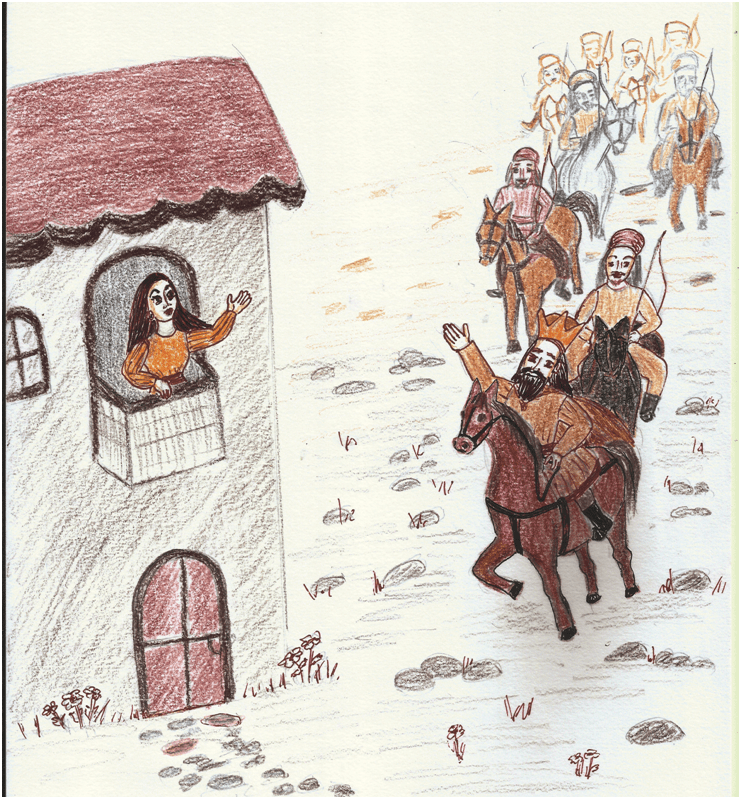
Khushru Parviz and Shirin knew each other from a very young age, and had tender feelings for each other, though Shirin was not from a royal family. Their friendship abruptly ended when Khushru had to leave Iran, to contend with Behram Chobin and then flee to Rome. The two got separated from each other for a long time, but none was able to forget the other. Years after they were separated, once when king Khushru had gone hunting, he passed through the city where Shirin stayed. When Shirin came to know of this, she was overjoyed. She got all dressed up and stood on the balcony of her house. When she saw Khushru, tears of joy started rolling out of her eyes and she cried out to him, reminding him of their past love. When Khushru heard her voice he looked up, saw her and his eyes too welled up with tears of joy.
Khushru stopped his entourage, met Shirin, and then asked his soldier’s to escort Shirin to the Queen’s palace. After returning from the hunt, he went to see her at the Queen’s palace, and the old love was rekindled. They were soon married.
The elders of the court were not happy with this development. They advised the king that marriage of a royalty with ladies from other social or religious strata always resulted in tragedy. They gave the examples of Zohak and Alexander. They requested Khushru not to make Shirin a part of his Queen’s palace. However, Khushru assured his courtiers that Shirin was nobly born, but her family had become poor on account of the vicissitudes of time.
Khushru’s prominence increased. On account of peace in the kingdom, the king spent more time in the Queen’s palace. Since Maryam was the chief queen, Khushru spent more time with her, which made Shirin jealous, as she had to spend long and lonely years all alone. It seems that it must be during this time that she may have developed soft feeling for Farhad (see story below). After some time, Maryam passed away and then Shirin was made the chief of the Queen’s palace, which had twelve thousand young maidens in it.
A story about queen Shirin, not mentioned in the Shahnameh, but popularized by poet Nizami in local tradition, is about her love with Khushru and then Farhad’s love for Shirin.
In this story, Shirin, an Armenian princess falls in love with prince Khushru and Khushru with princess Shirin, even without seeing each other, on the basis of their descriptions. Both set out to meet the other, Khushru going to Armenia and Shirin visiting Madayan. However fatefully their paths keep crossing several times, and they are were not able to meet. Finally, Shirin went back to Armenia, and Khushru returned to Madayan on account of his father’s death.
Then Khushru, chased out by Behram Chobin, went to Armenia and met Shirin, but Shirin did not agree to marry him till he claimed back the throne from Behram Chobin. Khushru left Shirin in Armenia and went to Rome to seek the Caesar’s help. The Caesar agreed to assist him on the condition that he marry his daughter Maryam, and not marry anybody else as long as Maryam was alive. With the help of Maurice, Khushru regained his throne. Maryam came to know about Shirin and Khushru’s past relationship and tried her best to Khushru away from Shirin. But fate had other choices, King Khushru met Shirin, married her and brought her to the queen’s palace, but Maryam kept the king away from Shirin, who started living a very lonely life in the palace.
Meanwhile, a court sculptor named Farhad, who specialized in carving sculptures for the king’s gardens, befriended Shirin, and in some time fell in love with her. Shirin also started to like Farhad. When the king came to know of this, he decided to break their alliance in a subtle manner. He set Farhad a difficult task in a far off place. He sent him off to the Behistun (Bisutun) stone Mountain with the near impossible tasks of carving a pathway for water from one side of the mountain to another for a garden, and finally preparing a huge bas-relief on the outer face of the Bisutun Mountain.
Farhad left off for Bisutun. In the hope of reuniting with Shirin he began his tasks in great earnest and quickly completed the first two tasks. The king was amazed at his ability. Farhad then started flattening the lower outer face of the Bisutun mountain, his third task, and was about to start reilefs on it.
When king Khushru, realized that Farhad was nearing completion of the third task and about to return, as he had almost finished the three tasks, he started thinking of ways and means to keep Farhad away from Shirin. A devious thought crossed the king’s mind and he sent a messenger to Farhad with the false news of Shirin’s death. Farhad was distraught on hearing this false news, and his desire to live in a world devoid of Shirin vanished. He threw himself from the mountaintop and gave up his life. A relieved Khushru then informed Shirin of Farhad’s death. Soon after this, Shirin too passed away.
Today this unfinished flattened face of the Bisutun Mountain still exists. It is two hundred metres wide and thirty metres high, and is referred to as “Farhad-Taraash.”
For the first twelve years of his reign, Khushru remained committed to maintain his friendship and loyalty with Maurice. However after the Roman emperor’s violent death in 602 CE, Khushru not only refused to accept the authority of his successor Phocas who had assassinated Maurice and his family, but also Khushru gave refuge to Theodosius, the only surviving member of Maurice’s family.
The eight years of Phocas’ reign was a disaster for the Byzantine empire. The new emperor was unable to deal with the developments in the kingdom, especially the might of the Iranian army. So he offered truce, but his peace overtures were rejected, and Khushru initiated a war with Byzantine. Theodosius was a part of many Iranian campaigns.
Khushru emerged victorious on account of his might and power, his tactical prowess, and also because of the rampant internecine warfare and civil wars in then Byzantine empire. It is reported that at the battle of Arkhamus, Khushru put together a ‘moving fort’ of armored elephants with cabs housing archers, and achieved a crushing victory, capturing the fort of Dara.
Between 604 and 610, many fortresses were captured by the Sasanian commander Farrokh Shahrbaraz across Mesopotamia, Syria, Palestine, Anatolia, Armenia, Edessa and Egypt. Sasanian general Shahen cleared the Byzantines from Caucasus in 611, thrust into Cappadocia and captured it by 613.
The civil war of the Romans in Syria and Palestine led to the execution of Phocas. Heraclius was invited by the Roman senate to take over the helm of the empire. The new emperor ruled from 610 to 641. He made pleas to Khushru for peace, but the Iranian emperor, who was on a winning streak, rejected his overtures.
The Iranian commander Shahrbaraz crushed Heraclius and his brothers and annexed Cilicia to the Sasanian empire, followed by Damascus in 613 and Jerusalem in 614. The Jews in Jerusalem were liberated but the Christian population was treated very harshly, and their patriarch Zacharias was imprisoned. The ‘True Cross’ also known as ‘The Holy Cross’, the Cross on which Jesus Christ was crucified, was taken to Ctesiphon and placed in the care of Khushru’s queen Shirin.
In 615 Khushru’s forces captured Anatolia and Chalcedon, and were at the gates of Constantinople. Never since Cyrus and Darius had Persian cavalry traversed such distances. In geographical expanse, Khushru had recreated the empire of Darius the Great. During the Sasanian times, this was the largest western expanse that any king had occupied. The Sasanian emperor commanded all of western Asia with the exception of Constantinople.
Khushru’s military continued its westward advance unopposed. First it captured Sardis in 616. No Iranian king since Cyrus the Great had achieved this. Rhodes Island, Constantia and Samos too came under the Sasanian command, followed by Alexandria in 619. By 621, all of Egypt had shifted from Byzantine power and was now under Iranian occupation. This was the second time in Egypt’s history that it was part of the Iranian empire.
In 619 the Turks and Hephthalites struck in north eastern Iran, and came close to Isfahan and Rae. After a few setbacks, Khushru’s Armenian commander Bagratuni was able to kill their leader and squash their attack.
However, Khushru’s fortunes in wars started declining from 622 when Heraclius, with an army of zealous Christians, describing his attack as a religious crusade, attacked the Sasanians in Armenia and defeated Shahrbaraz.
In 624 Heraclius went into the heartland of the Sasanian empire. He sacked the sacred Adar Gushnasp fire temple at Shiz in retaliation of the taking of the ‘True Cross’ by Khushru in 614.
In 625, Heraclius arrived in Cappadocia and went to the Caucasus. Though at first he was defeated by the combined Sasanian forces of Generals Shahen, Shahrbaraz and Shahrapakan, he was later able to overpower them. Shahrbaraz managed to escape, but Shahrapakan was killed.
In 626, Heraclius was again victorious at Constantinople. He achieved his victory in an interesting manner by allegedly intercepting a letter written by Khushru to his other commander Kardarigan asking him to remove Shahrbaraz or have him killed. This was because, Khushru was now suspicious and insecure about Shahrbaraz’s growing might and stature. Heraclius somehow showed this letter to Shahrbaraz and gained his support. Without his powerful commander Shahrbaraz by his side, Khushru lost to Heraclius and had to sue for peace.
Now Heraclius and the Khazars joined hands. To further cement the alliance, Heraclius gave the hand of his daughter to the Khakan of the Khazars. It was difficult for Khushru with his depleting forces to stand up against their combined might. In 627 they attacked and captured Albania and then moved south, but they were not successful in Armenia.
Khushru was finally defeated at Nineveh after a long drawn battle. Much of his elite infantry and cavalry was destroyed. The Iranian commander Rahzad (Razutis) also lost his life. Then the Romans proceeded to Khushru’s grand palace at Dastegard, looted the treasures and destroyed it in 628. Heraclius returned to Constantinople after destroying numerous other Sasanian palaces. Khushru ordered his remaining army to gather and guard Ctesiphon, where Heraclius was soon expected to arrive.
Now let us go back to the Shahnameh’s description of Khushru’s palace and palace intrigues. In the sixth year of the reign of king Khushru, Queen Maryam gave birth to a son. In those times, children born of nobility had two names. One was the private family name which the father uttered softly in the child’s ear, and the other the public name, which was announced aloud. The king uttered the child’s private name as Kobad in his ears, and the public name was announced as Shiroy.
When the astrologers were asked to foretell the events of Shiroy’s life, they gave a very grim prediction, saying that he will be harmful the country and its people. This greatly pained the king. His ministers consoled him as nobody could have power over the inevitability of fate. The king conveyed the tidings of the child’s arrival to its maternal grandfather, the Kaisar, who announced festivity in Rome. He sent lots of gifts for the child, his mother and the king. In a letter sent by the Kaisar, he requested Khushru to return the ‘True Cross’, which had been captured in a previous war. On receiving the letter, Khushru first thanked the Kaisar for his kind and generous words. However he declined to return the ‘True Cross’ as he feared that the Iranian people may regard such a gesture as a sign of him being favourable towards Christianity. He sent three hundred camel loads of presents to the Kaisar, which included ten camels laden with sacks of Dinars.
Since Behram Chobin was from Rae, and since its people were very faithful to him, Khushru wanted to destroy this province. His ministers advised him against it, as there were many good people too, over there. Then the king decided to punish the people of Rae by appointing a very bad leader for them. The ministers were surprised by the king’s decision.
The king found the ugliest and cruelest of persons and made him the head of the province of Rae. The man perpetrated atrocities on people and animals of Rae and so most people deserted the province. The king was happy with his revenge.
News of this reached Gordui, who then conveyed it to Gordiyeh, requesting her to do something about it. Gordiyeh talked to the king and convinced him to recall the tyrant leader and grant her the administration of Rae. The king, his purpose served, handed over the province of Rae to Gordiyeh.
King Khushru introduced several measures for happiness and safety of his kingdom and his subjects. He sent armies of twelve thousand soldiers each near borders of Rome, Zabulistan, Alāna and Khorasan to guard against any enemy intrusions in Iranian territory.
For his own life, the king divided his day into four parts. In the first part, the ministers were to inform the king about matters related to the army and the administration of the country, so that he can mete out justice. The second part of the day was dedicated to music, enjoyment and socializing with the courtiers. The third section of the day was devoted to prayers. The fourth part of the day was subdivided into two parts, one dedicated to learning astronomy and astrology, and the other, to be spent with beautiful maidens in his harem.
King Khushru also subdivided his month into four parts, for purpose of his own activities. The first part was for sports and archery, the second part was for hunting, discussing war strategy and playing intelligent games like chess and back-gammon. The third part was dedicated to writing and reading history. In the fourth part, the king met envoys and ambassadors from far off countries, and replied to their letters. On the day of Navroz, when the sun entered the house of Aries, the king secretly gave a lot of charities.
In 610 CE, Noman, the chief of the Arab state of Hira, situated between the Euphrates and Jerusalem, was attacked and imprisoned by Khushru. One of his commanders, the Shaybani leader Hani came to represent Noman before the Iranian king, but he too was imprisoned and later executed.
Khushru then ordered the Shaybani and Hira people to surrender, but they did not. Khushru sent an army comprising of Arab and Persian soldiers to overpower Hira and Shaybani. The two armies met at Dhu-Qar (near Kufa in modern Iraq). The Arab component of the Iranian army deserted leading to the defeat of the Iranians.
At his point of time prophet Mohammad had just appeared. This victory of the Arabs was a great morale booster, and gave an impetus to the Arab tribes to unite. It is said, that if the battle of Dhu-Qar had been won by the Iranians, the emergence of Islam would not have been the same, because the morale of the Arab tribes would have been destroyed.
It is a well-known fact that prophet Mohammad appeared during the reign of Khushru II. Though the Shahnameh does not mention this, Islamic tradition tells a story in which Prophet Muhammad sent a messenger Abdullah ibn Hudhafah as-Sahmi, to Khushru along with a letter in which the king Khosrow was asked to accept the religion of Islam. In the letter it was stated, “From Muhammad, the Messenger of Allah, to Kisra, the great (leader) of the Persians. Under the Command of Allah, I invite you to Him. He has sent me for the guidance of all people so that I may warn them all of His wrath and may present the unbelievers with an ultimatum. Embrace Islam so that you may remain safe in this life and the next. And if you refuse to accept Islam, you will be responsible for the sins of the Magi.”
Islamic tradition further states that Khushru tore up the prophet’s letter. He commanded Badhan, his vassal ruler of Yemen, to dispatch two men to bring the prophet to him. When Abdullah told Prophet Muhammad how Khushru had torn his letter, the prophet promised the destruction of the Iranian king stating, “Even so, Allah shall destroy his kingdom”.
The account of this righteous person is from Zoroastrian and Islamic traditions, and not from the Shahnameh. Dastur Dinyar, also known as Behzad or Rozbeh, was a saintly and knowledgeable priest during the reign of king Khushru II. However, he is more popularly known as Salman-i-Fars “Solomon (the wise man) of Persians”. In those times of internal discord and strife, Dastur Dinyar is said to have tried hard to bring about unity, amity and peace among the opposing factions of the Iranian royalty, and hence became unpopular among the warring factions.
He was arrested for a crime he did not knowingly commit. Tradition tells us that he inadvertently hurt his mother, and was hence forced to flee Iran, rather than be prosecuted. Some traditions say that the king himself helped him to flee as he was convinced of his piety and innocence.
He took refuge at Medina where he later became associated with Prophet Muhammad, who recognized his value. He became an asset to the prophet and assisted him in all his works. He helped the prophet in writing the Quran (Quran XVI-105).
The Prophet had constituted a council of advisers of which Dastur Dinyar was an important member, and belonged to his ‘inner circle’. He was also one of the most revered among the Ashab “companions” of the Prophet. In the Hadith, it is stated that “Salman Minna aht al-Bait”, that is, “Salman is one of us”.
There are traditions in the Islamic sources describing Salman and his journey to Islam. A chapter in the Hadith collection Bihar al-anwar “Oceans of light” is devoted to Salman’s journey and opinions about him by the Prophet and Shia Imams.
Dastur Dinyar survived the prophet and staunchly supported Ali and his family during the schism that followed the prophet’s passing away. Esoteric Islam began to blossom under Hazrat Ali in the influence of Salman-e-Fars.
It was on account of Dastur Dinyar’s wisdom, learning and piety, that he was referred to as Salman i Fars “the Parsi Solomon.”
Kharrād, the emissary of Iranian king Khushru was not able to persuade the Chinese king to handover the rebel Behram to the Iranian king. Hence he decided to change his strategy.
He was aware of Kalun, an aged Turkish warrior, who was a relative of Makātureh, and held a grudge against Behram after he had killed Makātureh. Right since that time, Kalun had wanted to avenge his death. Kharrād summoned Kalun and befriended him.
Just then Kharrād came to know that the princess of China was not well. He sent a message to the Cinese Queen conveying that he could heal her, as he had knowledge about medicine. The Queen agreed and the princess was healed by Kharrād. The Queen offered lavish gifts to him, but he politely declined, saying that he would ask for a favour from her at a later date.
Kharrād came to know that Behram with his army had reached Marv in Iran. He instigated Kalun to go to Marv and kill Behram, when he was alone. If he succeeded he was promised refuge in Iran and a city in gift from king Khushru. Moreover he would have the satisfaction of avenging his relative Makātureh’s death. Kalun agreed and set off for Marv. However, he needed a permit from the Chinese king to go to Marv. Kharrād knew how to arrange that.
Kharrād went to the Queen and requested her to get him a letter of permission to leave China by using the seal of the Khakan when he was asleep. The Queen who was obliged to Kharrād for saving her daughter, agreed. On getting the permit, Kalun immediately left for Marv.
On reaching Marv, Kalun waited for an opportunity to go to Behram when he was alone. Kalun got this opportunity one day. He reached Behram’s tent and sent a word that he had a message for Behram from his wife, the Chinese princess, which he needed to deliver to him verbally and in person, so that nobody else could hear it. Behram saw him from the window. He did not feel threatened by an old man, so he allowed him to come in. Kalun went in carrying a dagger in his sleeve. As soon as he went close to him, as if to say something in his ears, he drew the dagger into Behram’s stomach.
Behram fell writhing in pain. His soldier’s caught Kalun and mercilessly beat him up wanting to know who had sent him. Kalun did not utter a word though his hands and legs were broken. Then he was kept in isolation.
When Behram’s sister Gordiyeh got the news, she came rushing. She reprimanded him for wasting his life in backing the wrong persons. Behram felt repentant on his deathbed. He asked his sister and Yalān-sineh to always be together and look after each other. He sent an apology to Khushru, asking to be forgiven. Requesting his last resting place to be in Iran, Behram breathed his last.
When Khakan came to know of Behram’s death he grieved a lot. On inquiring, he came to know that Kharrād and Kalun’s were responsible for Behram’s death. He summoned Kharrād, but he had already fled. In revenge he had Kalun’s family killed and his village burnt. The whole of China grieved for Behram for some time.
Khushru, on hearing about Behram’s death, not only celebrated himself, but also announced festivities in the entire nation. By that time Kharrād had reached Iran. He was handsomely rewarded for eliminating one of the biggest enemies of Iran. The good tidings were conveyed even to the Roman Kaisar.
The Khakan realized that all the relatives of Behram must be without support, so he decided to help them. He called them from Marv to China. He offered to marry Gordiyeh, and make her his chief queen. Gordiyeh replied that she was agreeable to his offer, but she could go to him only after finishing the four months period of mourning.
Gordiyeh, in fact, was not in favour of the marriage, as she was an Iranian and the Khakan was Turkish. She consulted some elders and decided to flee to Iran. Some members of Behram’s family, including his brother, decided to go back to China. But Gordiyeh took weapons, wore an armour and took charge of the small of army of Behram. Along with commanders Yalan-sineh and Yazad-goshasp, they left for Iran.
Behram’s brother reached China and informed the Khakan about Gordiyeh’s decision to return to Iran. The Khakan immediately asked him to go to his sister and convince her to return or else he would fight with her. He sent another senior warrior by the name Tuborg to help him.
After four days, an army of six thousand soldiers caught up with Gordiyeh and her group. Tuborg, was not able to recognize Gordiyeh who had donned an armour and helmet, and had mounted a horse. He asked her the whereabouts of Gordiyeh.
After Gordiyeh introduced herself to Tuborg, he gave her the Khakan’s message and told her that the Chinese king had asked her to come to China even if she did not want to marry him, otherwise he would have to take her forcefully.
Gordiyeh challenged Tuborg to a fight, and said that if she would lose she was willing to marry anybody he chose. In the duel, Tuborg was killed and later the entire army sent by the Khakan was decimated. Gordiyeh, now did not know where to go, so she waited in Āmui. She sent a letter to her brother Gordui and asked him to relate to King Khushru all that had transpired. Gordui did accordingly.
In Iran, Khushru got his uncle Bandui mercilessly killed by hacking off his hands and legs, to avenge his father, king Hormazd’s death. Then, Khushru summoned his other uncle Gastaham from Khorasan. On receiving the message Gastaham immediately left for Iran through Sāri and Āmul. He was aware that Khushru had his brother Bandui killed, and he feared that the king would have him killed too as he was with his brother whilst killing king Hormazd. He had no option but to rebel.
When Gastaham came to know about Gordiyeh, he decided to join hands with her. The two met in the jungle, and Gastaham narrated his fears to her. He said that king Khushru never forgets old rivalries, and hence he will definitely take revenge with all those who were connected with Behram Chobin. Gordiyeh agreed with Gastaham, who then proposed her for marriage, and he being an Iranian from a noble family, she agreed to marry him.
When king Khushru came to know that Gastaham has disobeyed him by not coming and had married Gordiyeh, he became very angry. He asked Gordui to write a letter to Gordiyeh conveying her that she had always been on Khushru’s side even when Behram was alive, and even her other brother Gordui was his faithful advisor, so she need not worry about anything. Gastaham has misled her and she should punish him by taking his life. He promised to make her his queen and pardon her commanders and soldiers.
Gordui suggested that instead of himself going to Gordiyeh, he would send his wife with the letter explaining her everything and convincing her for the marriage. Khushru liked the idea.
On reading the letter Gordiyeh agreed to what her brother and the king had told her. With the help of five of her commanders, she killed Gastaham in his sleep. When Khushru came to know of this, he was very happy and he summoned her to his palace. In a short while, he officially made her his queen.
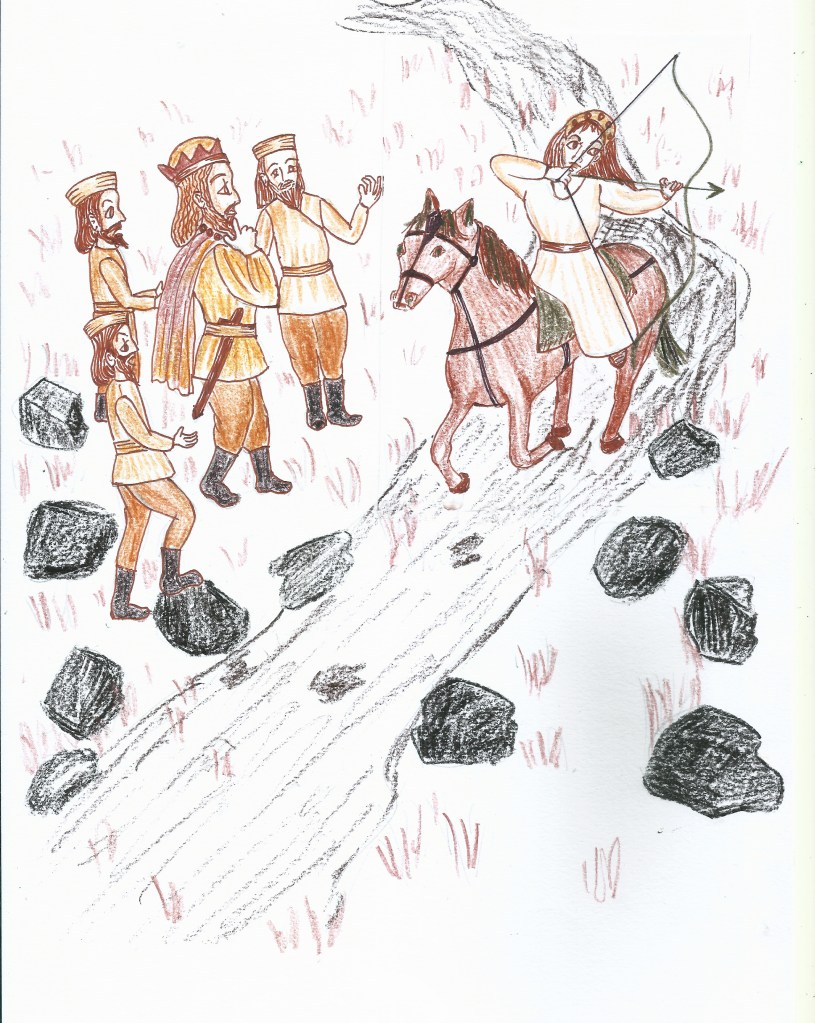
At the king’s request Gordiyeh displayed her skills in horse riding and wielding various weapons like spears, swords, mace and bow-arrows. The king was highly impressed.
Gordiyeh displaying her skills by shooting an arrow from a running horse. King Khushru is watching. Illustration by: Mrs. Katie Bagli.
However, queen Shirin cautioned the king, saying “Beware of this woman. She would become dangerous, the day the thought of avenging her brother comes to her mind.” The king laughed off the remark and told her that he was confident that she would always be friendly. After showing off her warrior like body and skills, the king asked her whether she was able to drink wine like a warrior. He offered her a large cup of wine, which she drank in one gulp without batting an eyelid. The king was amazed. Immediately, the king appointed her as the overseer of his personal bodyguards and the bodyguards of the harem.
Behram Chobin went to China to seek refuge and help from its king. The Khakan of China kept him as his guest. Both became very friendly and spent considerable time together, playing games and going on hunts.
Once Behram noticed that a Turk by the name Makātureh, came to the king every morning, both of them talked secretly and he gave him one thousand Dinār every day. Behram was perturbed by this behavior and asked the king. The king said that he was a very powerful warrior and controlled a large part of his army. He was daily asking him for money and threatening to withdraw his support, if he did not.
Behram said, “This is not at all fair. If you permit me I can save you from him, but you will have to do as I say.” The king agreed.
Then Behram told the Khakan, “When the Turk comes to you the following morning, do not be nice to him and don’t even look at him.”
The following day when the Turk came, the Chinese king acted as instructed by Behram. The Turk was furious. He abused Behram for instigating the king and challenged him to an archery duel the following day.
The two warriors met at a pre-determined place for a duel. The king and several courtiers gathered to see the two mighty warriors fight it out. In the duel, Makātureh lost his life. The king was relieved that he was relieved from a person who was constantly harassing him. He handsomely rewarded Behram.
A dangerous animal referred to as Shirkappi once emerged in the jungles of China. It was black in colour, bigger than a horse, and had two long horns. It was connected to the species of Azdah, since it too breathed fire.
The beast had taken away many young men and women. One day, when the Chinese princess had gone out with her friends, she too was taken away by Shirkappi. The queen was very distraught. She had heard about the heroic adventures of Behram, so she asked the king to request him to get back their daughter from Shirkappi.
Behram prepared himself and went to Shirkappi’s hideout. On seeing him, the ugly monster hid in the water. Behram waited for it to emerge from the water. After some time Shirkappi came out and went towards Behram to attack him. Behram shot three arrows which struck the beast, but it still had strength. Then Behram went up a mound and shot a spear at it, which fell the monster to the ground. Behram came down and cut the monster into two with his sword. He brought back the princess and returned her to her parents.
The king and queen were very happy, and so was the whole of China. The king lavished Behram with gifts and jewels. He also made him marry his daughter, so that he may continue to stay in China. He gifted him the province of Tartary and made him its ruler.
When King Khushru came to know of the prominent position given to Behram Chobin in the Chinese kingdom, he immediately took affront and wrote a letter to the king. He said that Behram was a rebel, and a usurper of the Iranian throne. He reminded the Chinese king that he himself had been badly humiliated by Behram in the past, and so elevating him in his court, will tarnish his name, and also make him look weak.
He ended by saying that giving Behram an eminent place in the Chinese court was akin to a challenge to the Iranian king. He asked the Khakan of China to arrest Behram and send him to Iran or else he will retaliate with an attack.
The Chinese king replied that he had held Behram’s hand in friendship, and he will not leave it now, or else it would ruin his reputation. On reading the letter, Khushru consulted his ministers and sent another letter to China.
When Behram came to know about the letter from Khushru, he was furious and asked the Khakan to attack Iran. The king consulted his ministers, and they agreed with Behram. The king selected two eminent warriors Chinui and Zangui, and sent them with Behram to attack Iran.
When king Khushru came to know that the Chinese king has decided to send an army with Behram, he sent Kharrād to China to negotiate with the Khakan. Kharrād was well received. He stayed there for a few days looking for an opportunity to talk to the king about Behram. One day, when he got an opportunity, he warned the Khakan about Behram, and asked him to hand over Behram to the Iranian king. The Khakan was not in favour of doing this, as that would amount to breaking his promise with Behram.
Kharrād realized that he would not be able to persuade the Khakan, so he changed his strategy. Continued……
The armies requested by the Kaisar for Khushru arrived. He added one lakh of his own soldiers and along with a lot of wealth, weapons, gifts and servants, sent it to Khushru. Along with that, he also sent Maryam, one of his princesses, as a queen for Khushru. Then he asked his brother Neyātus to lead the army to Khushru.
Neyātus met Khushru, along with the army. Maryam was presented to Khushru and he spent three days with her. Then he prepared to move towards Azarbaizan to go to Iran. He made Neyātus the commander of his army. On the way, he met Bandui and his friend Mausil who offered Khushru his army. The army of Nimruz also joined him.
When Behram Chobin came to know of Khushru advancing with the army, he prepared letters for Khushru’s commanders Gastaham, Bandui, Gordui, Shapur and Andiyān asking them to desert Khushru and come into his fold. He sent the letters with Dārā-panāh, one of his commanders.
When Dārā-panah reached Khushru’s army, he was awe-struck by its size and might. He and his commander Behram had expected something very small. Dārā-panāh did not like the betrayal, and he decided to go straight to Khushru and give the letters to him.
Khushru went through the letters and consulted his commanders. Together they decided to beat Behram in his own game, and prepared a reply, as if it was jointly written by the commanders. In the reply, Behram was informed that they would remain on Khushru’s side but fight for him against the Roman army. When Behram received this letter he was very happy.
Behram asked his commanders Yalān-sineh and Yazad-goshasp to prepare the army to attack Khushru. When the commanders approached Khushru’s army, they were over-whelmed by its sheer size. The combined army of Khushru was ready to take them on.
A Roman warrior by the name Kut asked Khushru whether he could go and fight Behram. Khushru allowed him to go. Kut was very easily defeated and killed, and so were many other Roman warriors, who went one after the other. Now, Khushru decided to send his Iranian army to fight Behram.
In the war, Khushru’s army met Behram’s army. Behram was on a white elephant. The Iranian warriors wounded the elephant, but Behram continued fighting on horse-back. He wreaked havoc in the enemy folds. Khushru first wanted to himself go and fight Behram, but his warriors stopped him from doing that.
Khushru’s warriors went to fight Behram. First Yalān-sineh and Azar-goshasp went, but both of them were defeated. Then Behram saw Khushru and followed him. Khushru started fleeing on his horse, but he soon realized that he had reached a dead end and there was no way he could escape. Just then, out of nowhere, a divine figure dressed in green, riding a white stallion, appeared before him.
The divine figure gently picked up Khushru and placed him in a safe place. A relieved Khushru could not control his tears at being saved from near death. He asked the figure, “Pray, tell me, who are you?”
The divine figure replied, “I am Sarosh Yazad. You will soon become the emperor of Iran. You are honest and divine. Never lose your piety.” So saying he disappeared from view.
Just then, Behram approached the place and saw Khsuhru talking to a divine figure. In exasperation, he exclaimed, “Uptil now, I was successful, as I had to just contend with humans. Now that I have to contend also with divine beings, I don’t think I could succeed.”
Neyātus and Maryam had seen Khushru being chased by Behram in the dead end. They were almost certain about his imminent death. Just then they saw Khushru coming from the other side of the mountain. They were shocked and surprised. Khushru narrated the whole incidence to his soldiers, and the entire army rejoiced. Now Khushru was confident that he will be able to regain his empire.
On the following day, when the war resumed, Behram tried to attack an unprepared Khushru, but he missed his mark. Khushru then followed Behram. The Iranian army was motivated by their king’s bravery. They followed Behram’s army which had started retreating.
Khushru announced that whoever decides to surrender should be pardoned. Many of Behram’s commanders and soldiers surrendered. When Behram became aware of this, he collected some treasures and fled.
Khushru sent Neyātus to follow Behram. The two met in a bamboo forest and fought each other. Neyātus was defeated and he pleaded for his life. Behram spared his life and asked him to go to Khushru and tell him that he had spared him. From there Behram proceeded towards Rae, from where he went to China. Now the coast was clear for Khushru to re-occupy his throne.
Khushru entered Ctesiphon in 591 CE and re-occupied the throne. He sent a letter to the Kaisar informing him about the developments. The Kaisar was very happy. In a return letter he praised him, and with it sent some clothes, ornaments, a jewel studded cross and wealth. When Khushru received this he was not sure whether to wear the rich clothes, as there was a cross on each clothe and he would run the risk of being called a Christian.
His minister however told him that by wearing the clothes he would not become a Christian, as he was a staunch Zoroastrian at heart. So Khushru wore the clothes. On seeing him, some of his courtiers understood that he had done this just to please the Kaisar, but others accused him for sympathizing with Christians and Christianity.
After Khushru ascended the throne, he had the difficult responsibility to keep both the Zoroastrians and the Christians happy in his court. One day when Khushru was having food and drinks with his courtiers, he had worn the robes with the cross, presented to him by the Kaisar. The courtiers were not happy with this.
Once, when Khushru was praying the bāj before food, holding a barsom in his left hand, Neyātus stood up and shouted at the king, accusing him of insulting Christ by wearing a cross and doing Zoroastrian prayers and rituals. This attitude angered Bandui, and he immediately stood up and slapped Neyātus.
A furious Neyātus stormed out of the court and sent a message to the king that he immediately wanted him to hand over Bandui to him or he would attack. Khushru was distressed at Neyātus’ behavior. He realized that this man could endanger the good relationship he shared with the Romans.
Just then Maryam approached the king and requested that she be allowed to play the mediator and pacify Neyātus, who was her paternal uncle. She went to him with Bandui and calmed him down. The Roman realized his mistake and there was reconciliation.
Khushru then sent Neyātus and the Roman soldiers back to Rome with lots of presents. He rewarded his faithful warriors Bandui, Gastaham, Burz-meher, Ram-barzin, Shapur, Andiyān, Gordui and Bālui by giving them lordship over provinces. He made Tokhāre the treasurer and Kharrade the Commander-in-chief of the armies. He handsomely rewarded all advisors and soldiers who had remained faithful to him.