
Queen Purāndokht (630)
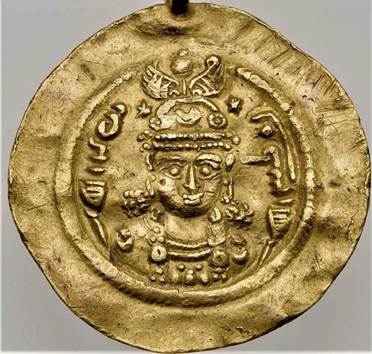
Purant-dokht on her only gold coin
For a short time, anarchy prevailed in Iran as there was no ruler. The sons of Shahrbarāz were so scared that they did not come forward. None of the princes of Khushru Parviz were traceable and hence Shehrān, as a last resort, gave the throne to Purān-dokht, also referred to as Purān, one of the princesses of king Khushru Parviz.
Purān-dokht was very intellectual and fond of reading. She maintained good relations with the Roman, who too accorded her the highest respect. She sent the patriarch of the Nestorian Christians, who was imprisoned when Iran and Rome were aggressively at war, back to Rome.
Purān-dokht continued her father’s legacy and reverted back to the administrative system and even the coinage types to her father. She also minted gold coins which were ceremonial in nature and not meant for wider circulation. On the coins, she called herself yazdān tokham “descended from the divine beings”.
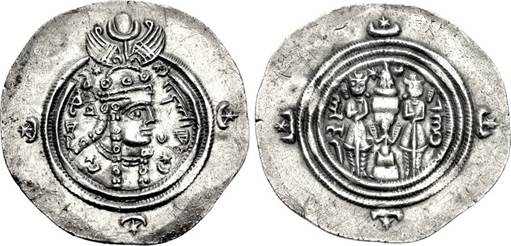
A profile of Puran-dokht with fire altar on the revers
She punished her brother Piruz for murdering the young king Ardeshir. As he was in hiding, she asked her warriors to search for him. Once he was caught, he was tied to a pony, dragged and stoned to death.
Purān-dokht ruled for about a year, then fell ill and passed away. Some reports indicate that she was suffocated by a pillow in her own bed.
Queen Āzarmi-dokht (631 CE – 4 months)
Āzarmi-dokht, also called Āzarmi, was Khushru Parviz’s daughter and Purān-dokht’s sister. She was the second Sasanian queen of the Sasanian dynasty. She ruled justly and firmly for four months.
A nobleman by the name Farrokh Hormazd, in order to strengthen his authority, asked Āzarmi-dokht to marry him. However, when she declined, he stopped supporting her and established himself as a rebel king in Istakhr.In order to deal with him, Azarmidokht allied herself with Siyavakhsh, the grandson of Bahram Chobin, and had Farrokh Hormazd killed.
Farrokh Hormazd’s son Rostam Farrokh-zād, who was at that time stationed in Khorasan, succeeded him. In order to avenge his father, he led troops to Ctesiphon, the capital of the Sasanian Empire, defeated the queen’s forces and captured Ctesiphon.
Shortly afterwards Āzarmi-dokht was assassinated, once again leaving Iran without a monarch.
King Farrokhzād (631)
After Āzarmi-dokht’s death, the Iranian throne lay vacant, and hence Farrokhzād, a general and a senior courtier, was asked to occupy it. Justifying his position, he said that he was related to the royal family and hence was worthy of the throne. He proved to be a good king.
He had an attendant by the name Siyāh-chashm, who liked an attendant lady and asked her to stay with him. The lady complained to the king, who imprisoned Siyāh-chashm. However, on the requests of courtiers, he was set free, and he again started attending on the king.
Siyāh-chashm was awaiting a chance to avenge his humiliation and soon enough, he got his chance. One day, taking the opportunity of being alone, he poisoned the food of the king, who died soon thereafter. Once again the Iranian throne was without a king.
4 Pretender kings (632-635)
At this period of time, the situation in Sasanian Iran was such that the institutions of kingship, nobility and clergy were shaken. Military generals took opportunity of this and frequently assumed power. Several pretenders and usurpers under various names assumed power for short periods and in quick succession. These contender kings were either assassinated or imprisoned by other commanders and generals claiming to be distant members of the Sasanian royal family.
At times several contenders ruled simultaneously at different places and occupied different areas of the empire like Khuzestan, Pars and Kerman. Hence this period is unclear in terms of succession. These contender kings, under their assumed names, ruled from 632 to 635. They were Khushru III, Piruz II, Khurzad Khusro (Khushru IV) and Hormazd V. In fact, some of them were still on the throne when Yazdezerd III assumed power. Thus, in a short period of four years (628-632 CE), ten monarchs ruled over Iran, most of them falling victims to internecine strife. It was in such deplorable conditions, that the last Sasanian Emperor Yazdezerd III ascended the throne.
 Ramiyar Karanjia