
Yazdezerd Sheheryar/Yazdezerd III (632 – 651) (Part 2)
Battle of Qadesiya
The Iranians started preparations for a fresh attack by collecting an army of more than a hundred thousand soldiers under General Rustam Farrokh-zād. They realized it was a do or die situation. After crossing the Euphrates they challenged the Arab forces who were under the command of Saad bin Waqqas at Qadesiya near Kufa in Sasanian Iraq.
The Sasanians had three times the number of troops, but many of them were newly recruited soldiers, whereas Caliph Omar had provided Waqqas with the best of soldiers and supplies. The morale of the Arabs was high after their victory against the Byzantines in Syria. Rustam sent an emissary to bring a peaceful end to the conflict. Waqqas sarcastically replied that Arab warriors were a hardy lot who did not want fancy clothes and rich food like the Iranians. Their only motive was to make the Iranian king accept the religion of Prophet Mohammad. If he was agreeable, then there would be no war. Rustam retorted that the Iranians would never accept the Islamic religion and that they were prepared for the war.
The battle of Qadesiya lasted for four days. On the first day, both the sides seemed to have known the tactics of the other side. The Sasanians used their elephants to scare the horses of the Arabs, but the Arabs surrounded the elephants and forced their riders to dismount. Rustam ordered a withdrawal.
On the second day of the battle, both the sides were fighting equally well. Soon enough, two Iranian generals Bandsuwan and Behman lost their lives and the Arabs had an upper hand. Moreover, the Iranian camp experienced water shortage. They were not able to fight in the excruciating heat. On the other hand the Arabs were adequately reinforced. Iranians lost almost ten thousand men, whereas the Arabs joust lost about two thousand of their troops.
On the third day, the Arabs found a way of blinding the battle elephants of the Iranians. As a result of this, the huge beasts took to flight. There was relentless fighting throughout the day with the artillery and cavalry fighting with swords and spears. The inexperienced Iranian soldiers were exhausted and Rustam once again gave orders to his army to withdraw.
On the fourth day, just when Rustam was having the upper hand and Sasanians were approaching victory, a violent sand-storm emerged which blew huge clouds of sand into the faces of the Sasanian soldiers. The Arabs however fought with their backs to the storm.
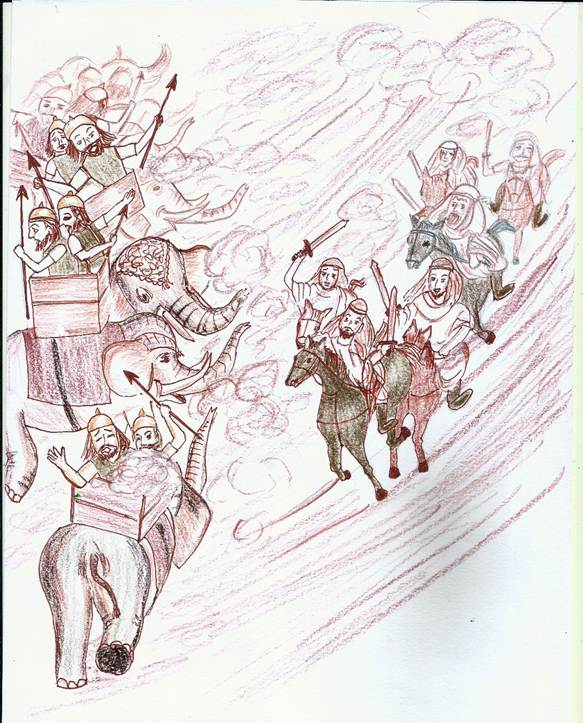
Sand-storm coming on the Sasanian soldiers. (Illustration by Mrs. Katie Bagli)
The Iranian soldiers, blinded by the sand were not able to press for the final attack. The Arabs soon reached Rustam through a breach in the Sasanian defense. The brave Rustam who was trying to seek refuge from the stormy wind, was killed by the sword of an Arab warrior. The Arabs were jubilant. When the Sasanian soldiers heard the news of the death of their commander, they began to flee in a disorganized manner. That day, the Iranians lost forty thousand soldiers, whereas the loss of the Arabs was numbered at just six thousand.
In the battle of Qadesiya, despite all their efforts, the Iranians lost their national standard, the Drafsh-e-Kāvyāni. This was a massive psychological blow to the Iranians, who had also lost almost one thirds of their entire army.
After this defeat, many Iranian soldiers defected and joined the Arabs. Since the Arabs too had lost about one-thirds of their force, there was a respite for about eighteen months, in which period, they re-inforced their position at Basra, Kufa and at the right bank of the Euphrates. The Arabs relentlessly kept on planning their next attack, and this time their target was the capital city of Ctesiphon, referred by them as Madayan ………
 Ramiyar Karanjia